Key Takeaways
 Biotin and vitamin B5 share an absorption pathway, but biotin's effect on acne is still unproven.
- Over-the-counter biotin often comes in 5 to 20 mg doses, hundreds of times the 30 mcg adults need.
- Biotin can make some thyroid, hormone, and troponin blood tests read falsely high or low.
- The best-designed trial of biotin for hair growth found no difference from a placebo.
Hair vitamins got their glow-up when Kim Kardashian posted herself biting into biotin-packed gummy bears on Instagram. And since then, biotin (vitamin B7) use has kept climbing as people take it for healthier hair, skin and nails. But despite finding its way into many self-care regimens, dermatology providers rarely recommend biotin supplements.
Part of the reason is your skin. For some people, those gummies may bring breakouts instead of the glow they promise, and there isn’t much on the hair side to make up for it. A 2024 review found just three studies of biotin for hair, and the best one showed no difference from a placebo.
Quick Answer: Can Biotin Cause Acne?
Biotin may cause acne in some people, and the leading theory is that it competes with vitamin B5 (pantothenic acid) for absorption. But that link hasn’t been proven in people, despite plenty of anecdotal reports.
Either way, Honeydew providers generally don’t recommend biotin unless you have a diagnosed deficiency.
Why Might Biotin Cause Acne? The B5 Competition Theory
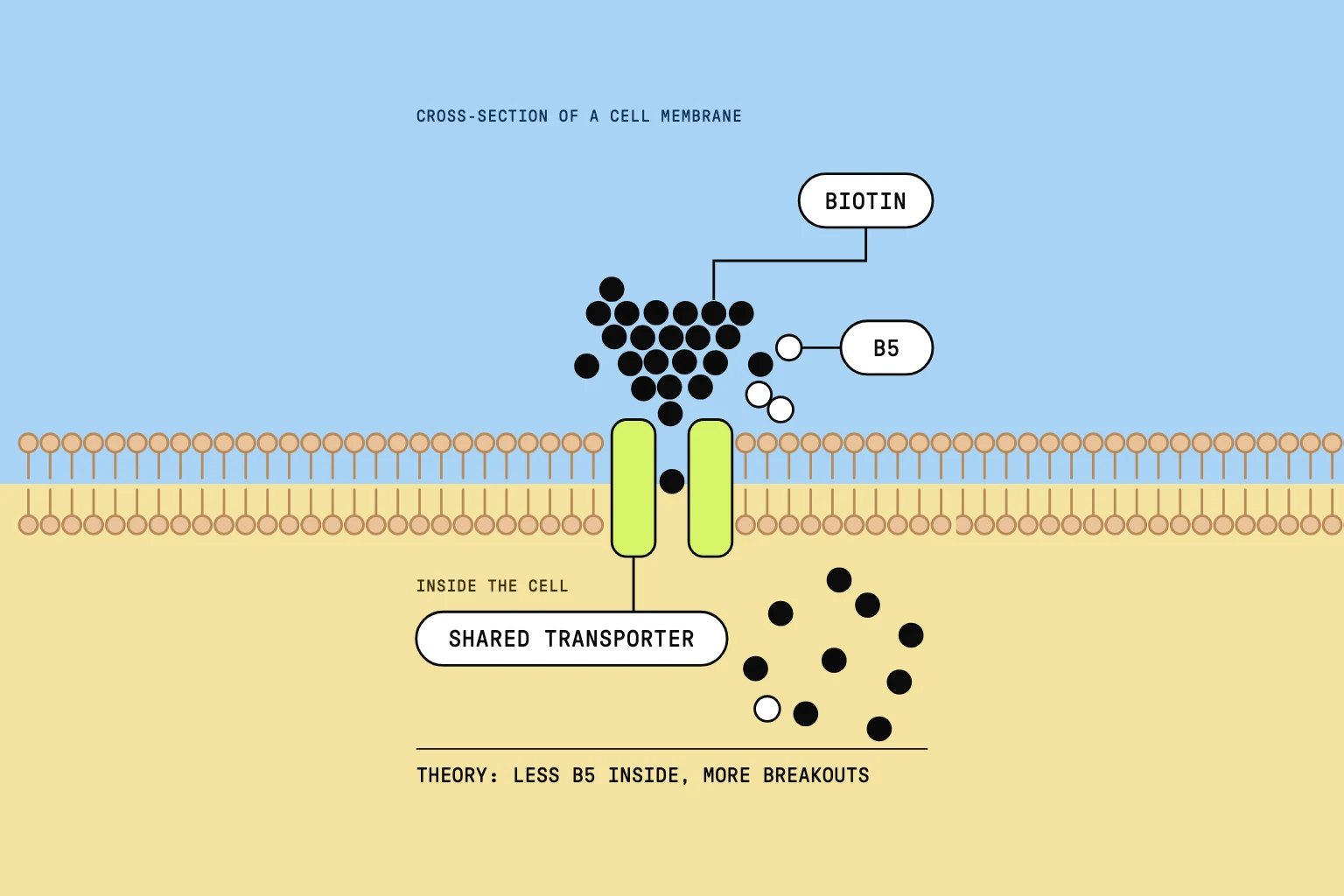
Biotin might cause acne by competing with vitamin B5 (pantothenic acid) for absorption. Both vitamins enter your cells through the same transporter, like two guests sharing one doorway, so a large dose of biotin could leave less room for B5. Since a shortage of B5 has been proposed as a cause of acne, that could, in theory, set the stage for breakouts.
How Biotin and B5 Compete for Absorption
Biotin and B5 both rely on a transporter with a mouthful of a name: the sodium-dependent multivitamin transporter (SMVT). When researchers first identified it in 1998, they found it carries B5, biotin, and lipoic acid. Later that year, a study of human colon cells confirmed that biotin shares the carrier with B5. And a 2026 structural study found that all three dock at the exact same spot on the transporter.
On paper, that makes competition between biotin and B5 plausible. But these are lab studies of cells and proteins, and none of them looked at B5 levels or skin in people taking biotin supplements.
What Happens When B5 Levels Drop
Your body turns B5 into coenzyme A, a molecule it relies on to process fats. Through coenzyme A, B5 also helps regulate your skin's barrier and the way new skin cells mature. Researchers who have tested B5 for acne suggest it may also have antibacterial and skin-softening effects, and studies in mice have hinted at a link between coenzyme A and inflammation.
A 1995 hypothesis paper went further, proposing that acne stems from a shortage of B5 and that very large doses of it could clear acne. If B5 does matter for acne, and if biotin lowers B5, then biotin could feed breakouts. Neither link has been proven in people.
Keep in mind: Most explanations of biotin breakouts you’ll find online point to B5, but no randomized controlled trial has tested the theory with acne as the outcome.
What Does the Research Say About Biotin and Acne?
Not much, directly. A 2024 review of popular acne supplements found that combination products containing biotin, along with ingredients like probiotics, zinc, and nicotinamide, improved acne scores. With so many ingredients in the mix, though, the effect of biotin on its own is still unclear. Some of the supplements the review looked at even list biotin and B5 together.
Dermatologists do hear about it, though. One told EatingWell that some people report whiteheads and blackheads after taking biotin, even though research hasn’t shown a direct link.
So can biotin cause acne? Johnathan Moore, PA-C, puts it plainly: “In theory, yes it can, but there is no solid evidence to prove it.”
The B5 Trial Behind the Theory
The closest thing to clinical evidence tests B5, not biotin. In a 2014 trial, 41 adults with mild to moderate acne took a pantothenic acid supplement (2.2 grams of B5 a day) or a placebo for 12 weeks. The B5 group ended up with significantly fewer total breakouts.
However, there are some caveats. The study was small, sponsored by the company making the supplement, and even the authors wrote that they didn’t understand the exact mechanism in play.
Showing that extra B5 may help acne also isn't the same as showing that biotin makes it worse. Lab studies of the shared transporter show the two vitamins can compete in cells, not that they do in people taking supplements.
Who Should Think Twice About Biotin?
Since the acne link is unproven, no one can say who's most likely to break out. The evidence is clearer about who has little to gain, or something to lose, from a daily biotin habit.
| WHO | WHY IT MATTERS | WHAT THE EVIDENCE SHOWS |
|---|---|---|
| Acne-prone people on high-dose biotin | Sebaceous glands are already more reactive; even small shifts in B5 levels or sebum production can trigger breakouts | Unproven, since studies haven't isolated biotin's effect on acne |
| Anyone due for blood work | Biotin can skew thyroid, hormone, and troponin results | A single 10 mg dose interfered with thyroid tests taken within 24 hours |
| People taking it for hair or nails | They may be paying for little benefit | Hair benefits have been reported only in a few children with a rare hair disorder |
| People taking several supplements | They may be getting more biotin than they realize | Biotin is sold alone, in B-complex products, and in some multivitamins |
For people taking biotin for hair loss, accurate blood work matters even more. Over 40% of people with alopecia areata have thyroid antibodies, and a 2026 review flags biotin as a potential, though unproven, cause of misread thyroid tests in this group.
Important to know: The FDA has warned that biotin can significantly interfere with certain lab tests and cause incorrect results that may go undetected. That includes troponin tests, which help diagnose heart attacks. The agency has continued to receive reports of falsely low troponin results, and one patient taking high-dose biotin died after one.
Biotin Dosage: How Much Is Too Much?
There’s no official upper limit for biotin, since your body flushes the extra out in urine. Still, typical over-the-counter doses of 5 to 20 mg a day run 167 to 667 times the 30 mcg adequate intake, and none of these amounts has been tested for acne. Here’s how common doses compare.
The dose of biotin you are taking matters significantly when it comes to acne risk. Here is how common biotin doses compare and what level of concern they carry.
| BIOTIN DOSE | WHERE IT SHOWS UP | COMPARED WITH 30 MCG | WHAT'S KNOWN |
|---|---|---|---|
| 30 mcg | The adequate intake for adults; Western diets average about 35–70 mcg a day from food | 1x | Enough for most people |
| 2.5 mg (2,500 mcg) | The dose used in small nail studies | 83x | None of those studies had a placebo group |
| 5–20 mg (5,000–20,000 mcg) | Typical over-the-counter doses | 167–667x | Can interfere with thyroid function tests |
More isn't better, though, and Johnathan Moore, PA-C, reminds his patients of exactly that.

“One thing I always remind patients in general is that more vitamins does not necessarily mean better results. Most people already get enough biotin through their diet, and taking thousands of times the amount your body needs isn't going to give you thicker hair or healthier skin. In fact, unless you're deficient, there's very little evidence that extra biotin provides any benefit.”
— Johnathan Moore, PA-C | Physician Assistant
If you do take biotin and your skin has changed, a few clues can help you sort out whether it's involved.
How to Tell If Biotin Is Causing Your Acne
No test can confirm biotin as the cause. Looking at a few patterns can help you and your provider decide how likely it is.
- Timing: Did the breakouts start after you began biotin, or a hair gummy, B-complex, or multivitamin that contains it? The closer the timing, the more it's worth a look.
- Every label: Biotin isn't always the headline ingredient. It turns up in B-complex products and multivitamins, and even in some acne supplements.
- Other changes: New skincare, stress, hormones, or another supplement can trigger breakouts on their own. Whey protein is a recognized contributor to acne flares.
- A pause and photos: If you stop biotin, keeping the rest of your routine the same and taking weekly photos makes it easier to see whether your skin changes.
If the timing points to biotin, here's what generally helps.
What to Do If Biotin Is Causing Your Breakouts
If biotin looks like the trigger, you don't have to choose between your skin and your hair goals. Biotin's hair benefits are unproven for most people anyway.
- Pause it or cut back: If breakouts started after you began biotin, stopping is the simplest way to see whether it's involved. Since most diets supply enough biotin and true deficiency is rare, it costs most people little.
- Get to the root of hair worries: Hair loss has many possible causes, including stress, crash diets, some medicines, anemia, and thyroid disease. A provider can usually find the cause with a history and exam, and will likely recommend a supplement if you have a vitamin deficiency. Treatments made for hair loss, like minoxidil applied to the scalp, are another option a provider may suggest.
- Lean on food: Food supplies biotin in everyday amounts. Good dietary sources of biotin include:
- Eggs: about 10 mcg per cooked egg, a third of what adults need
- Salmon: about 5 mcg per 3-ounce serving of canned pink salmon
- Sunflower seeds: about 2.6 mcg per ¼ cup
- Sweet potatoes: about 2.4 mcg per ½ cup, cooked
- Almonds: about 1.5 mcg per ¼ cup
- Spinach and broccoli: smaller amounts, under 1 mcg per ½ cup
Red flag: If you've stopped biotin and your acne isn't improving, biotin may not have been the cause, or something else may be keeping breakouts going. Acne that sticks around, hurts, or leaves marks is worth a dermatology provider's evaluation.
Does Biotin Actually Work for Hair and Nails?
For most people, probably not. That 2024 review concluded that biotin's use as a hair supplement "is not supported by high-quality studies," despite how popular it is. The NIH notes that claims for hair, skin, and nails are supported, at best, by a few case reports and small studies.
One dermatology department chair put it bluntly to CNBC: “I tell my patients, please don't take [biotin].”
People with a true deficiency are the exception. Rare conditions like biotinidase deficiency are treated with biotin for life, and that kind of supplementation should be guided by your provider.
According to Johnathan Moore, PA-C, for everyone else, the downside goes beyond wasted money.
“Not only are people taking it without any benefit, but it may actually be doing them harm by throwing off other labs! One thing many patients don't realize is that high doses of biotin can interfere with certain blood tests, including thyroid function tests, hormone levels, and even troponin, which is used to help diagnose heart attacks. Depending on the test, biotin can make results appear falsely high or low, potentially leading to an incorrect diagnosis. I always recommend telling your healthcare provider about any biotin supplements you're taking before getting blood work done.”
— Johnathan Moore, PA-C | Physician Assistant
What you should know: How long biotin keeps affecting blood tests depends on the dose, your kidneys, and the test. At over-the-counter doses, 24 to 72 hours off biotin is often enough before thyroid testing.
When to See a Dermatologist
Pausing biotin is a reasonable first step for mild breakouts. But acne is a medical condition, and acne that's persistent, painful, or scarring is better treated than waited out. Consider seeing a dermatology provider if:
- Your skin hasn't improved after stopping biotin: Something else may be driving it.
- You're getting deep, painful lumps: Cysts and nodules sit deep under the skin.
- Breakouts leave marks: That includes dark spots and acne scars.
- Acne you already had got worse: A change in your usual pattern deserves a fresh look.
- You're not sure what's behind it: It could be hormonal, bacterial, supplement-related, or a mix.
A dermatology provider can work out the cause and build a plan around your acne type. Options in the 2024 AAD guidelines include:
- Topical retinoids (like tretinoin) to unclog pores and promote healthy skin cell turnover
- Topical or oral antibiotics (like doxycycline) to reduce bacteria and inflammation
- Spironolactone for acne driven by excess androgens and oil production
- Isotretinoin (Accutane) for persistent acne that has not responded to other treatments
Our dermatology providers treat acne of every type, whether it's tied to supplements, hormones, or something else. Care is managed 100% online, and same-day consults are available.
Honeydew Recommends
Our providers recommend skipping biotin supplements unless a provider has diagnosed a deficiency, and telling your care team about any biotin you take before blood work. If your breakouts started around the same time as a biotin supplement, stopping it is a low-cost first step.
For most people, biotin does little for hair, skin, or nails, but it can skew blood tests. Even with the acne link unproven, that’s a poor trade.
This matters most if you’re acne-prone, take a hair, skin, and nails supplement, or have blood work coming up. See a provider if breakouts don’t improve after you stop biotin, or if they hurt or leave marks.
We can’t say biotin caused your breakouts, and stopping it won’t clear acne with other causes. If you have a diagnosed deficiency, though, biotin may be exactly what you need, with your provider’s guidance.
At Honeydew, you can book an appointment to one of our board-certified dermatologists online and talk about your skin history and discuss a personalized treatment regimen. Your first consultation is free. Membership for most care starts at $25/month with an annual plan, and Accutane care starts at $50/month with an annual plan. Medications aren't included in the membership; they're prescribed to outside pharmacies and may be covered by insurance. The membership is HSA/FSA eligible.
Start your free online consultation and find out what's really behind your breakouts.

Medically Reviewed by
Johnathan Moore, PA-C
Physician Assistant