Key Takeaways
 Neither drug label lists an interaction between them, but taking both requires separate lab tests and following isotretinoin’s strict pregnancy rules.
- In a 2026 trial, adding spironolactone to isotretinoin cut lesions 80% in 8 weeks vs 74% on isotretinoin alone.
- People who can become pregnant need two forms of contraception from 1 month before to 1 month after isotretinoin.
80% fewer acne lesions in eight weeks: that's what adding spironolactone to low-dose isotretinoin did in one trial. Isotretinoin alone managed 74%. The trial was small and limited to women with high androgen levels, but it flips a common worry. Two strong acne pills at once sounds like asking for trouble.
Maybe you already take spironolactone and your provider has raised Accutane (isotretinoin). Or you're mid-course and wondering about adding it. Either way, the question is the same: is it safe to take both?
Quick Answer: Can you take spironolactone and Accutane together?
Yes: neither drug's label lists an interaction with the other. What matters most when taking both acne medications is pregnancy prevention, since both drugs can harm a developing baby. Honeydew's providers may pair them for hormonal acne, with one care team running both prescriptions and labs.
Here's what each drug's label says, why a provider might prescribe both, which blood tests to expect, how the pregnancy rules work, and whether spironolactone fits better after Accutane.
Is there a known interaction between spironolactone and Accutane?
There's no documented interaction between spironolactone and Accutane. The isotretinoin label lists just three interaction categories: vitamin A, tetracycline antibiotics, and oral contraceptives. Spironolactone isn't one of them.
The spironolactone label doesn't mention isotretinoin either. Its interaction list covers drugs that can raise potassium, plus lithium, digoxin, aspirin, and NSAIDs, the anti-inflammatory pain relievers that include ibuprofen. No retinoid, the drug family isotretinoin belongs to, appears on it.
No listed interaction isn't the same as long experience with the pair, though. Most of what's known about taking them together comes from small, short studies. That's why the combination is generally treated as a prescriber's decision, not something to add on your own.
One overlap matters. Ibuprofen is an NSAID, and joint pain is among the most common side effects on the same isotretinoin label. If you take ibuprofen regularly while on both drugs, tell your provider, since NSAIDs can push potassium up. And if the two drugs don't clash, the next question is why anyone would take both.
Why would a provider prescribe spironolactone and isotretinoin together?
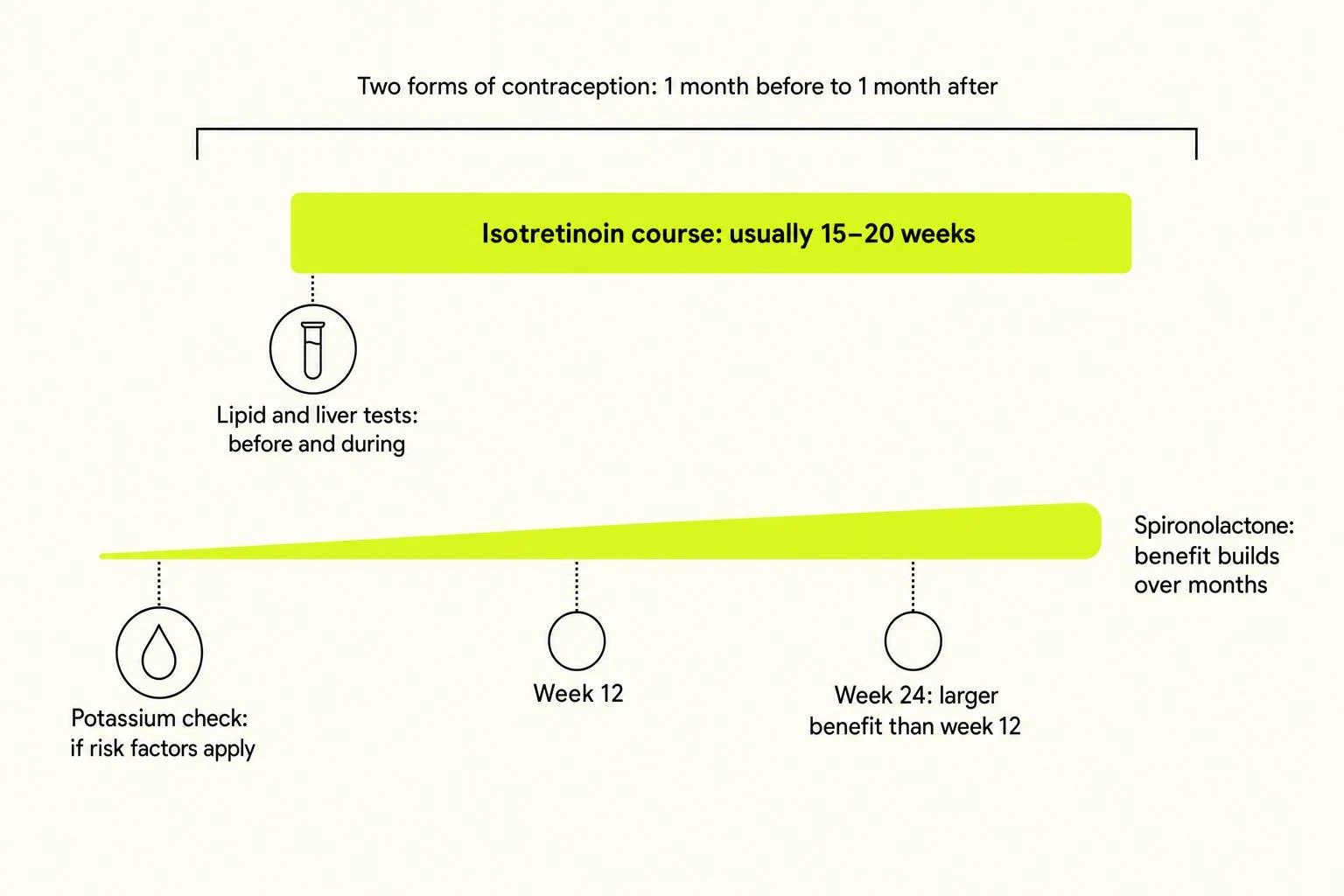
The two drugs work on acne from different directions. Isotretinoin, a retinoid, shrinks oil glands and cuts sebum (skin oil) over a course that usually runs 15 to 20 weeks. Spironolactone, an androgen receptor blocker, keeps hormones like testosterone from revving those glands up. The AAD guidelines list it as a conditionally recommended option for acne.
That hormone angle is what made researchers curious. In one small study of 36 women taking 20 mg of isotretinoin a day, levels of DHEA, a hormone that helps drive acne, rose over three months. The authors suggested adding an anti-androgen such as spironolactone.
A 2026 trial put that idea to the test. It randomized 112 women with acne and high androgen levels. Those on isotretinoin plus 40 mg of spironolactone a day saw a modestly bigger drop in lesions at eight weeks than those on isotretinoin alone, with acceptable tolerability. The study was short and run at one center, and patients knew which treatment they were getting. So it can't speak to long-term results or relapse.
Here's how the two drugs differ on the things that shape day-to-day care. Our comparison page covers how the two compare as standalone treatments.
| FACTOR | ACCUTANE (ISOTRETINOIN) | SPIRONOLACTONE |
|---|---|---|
| How it works | Shrinks oil glands and cuts oil production | Blocks androgen receptors, so hormones stimulate oil glands less |
| Typical timeline | One course, usually 15 to 20 weeks | Builds over months; gains were larger at week 24 than week 12 in one trial |
| Routine labs | Fasting lipids and liver tests before and during treatment | Potassium, per the label; rarely abnormal in healthy young women |
| Pregnancy | Never used in pregnancy; two forms of contraception plus the iPLEDGE safety program | Avoided in pregnancy; may affect a male fetus's sex development (rat data) |
| Most common side effects | Dry lips, dry skin, dry eyes, joint pain | Period changes, breast tenderness; dizziness less often |
Their side effects mostly don't overlap. Isotretinoin is best known for dryness, while spironolactone more often brings period changes and breast tenderness, and sometimes dizziness.
When Sarah Kenis DNP, DCNP prescribes spironolactone and isotretinoin together, she advises the patient about the side effects

“Each medication works differently and has its own potential side effects. Isotretinoin is more commonly associated with dryness, while spironolactone may cause menstrual changes or dizziness. Taking them together does not mean that you’ll experience more side effects or that any side effects will be amplified.”
— Sarah Kenis, DNP, DCNP | Dermatology Nurse Practitioner
Two drugs also means two sets of checks.
What blood tests do you need on both medications?
On both drugs, you're following two monitoring tracks, and they can often share one blood draw. Isotretinoin typically requires monitoring of liver enzymes and fasting lipid tests. Spironolactone monitoring is a little different as routine lab monitoring of potassium is typically not necessary for otherwise healthy younger women being treated for acne. Your provider will consider your age, kidney function, other medications, and medical history to decide if potassium testing is needed when taking spironolactone. Regular monitoring may include:
- Lipid panel (Accutane): cholesterol and triglycerides, checked before you start and at intervals until your response is clear, usually within about 4 weeks.
- Liver function (Accutane): tested before treatment and periodically during it.
- Potassium (spironolactone): high potassium, called hyperkalemia, is the main lab concern with spironolactone.
- Blood pressure (spironolactone): the drug is also prescribed to lower blood pressure, so readings may be part of spironolactone treatment follow-ups.
Potassium is where the label and the acne research part ways. Among 974 healthy young women taking spironolactone for acne, the hyperkalemia rate was 0.72%, matching the 0.76% baseline for that group. The authors judged routine checks unnecessary for them.
Age changes the math. In a 2019 study of patient records, 2 of 12 women aged 46 to 65 developed high potassium after starting spironolactone, compared with 1 of 112 aged 18 to 45. The authors called for monitoring after 45. Dermatologists typically weigh a potassium test for people over 45, anyone with kidney problems, and people taking potassium supplements, salt substitutes, or other potassium-raising drugs.
What to expect: Accutane labs usually happen at the start of a course and at follow-ups. If your provider orders a potassium check, it can usually be drawn at the same visit. Many of these tests can run through your insurance: we accept insurance for eligible lab work.
Sarah Kenis, DNP, DCNP always looks at the whole clinical picture:
“The same bloodwork is not needed for every patient on spironolactone due to differences in current medications, age, and medical history. The goal is always to monitor patients safely without ordering unnecessary bloodwork.”
— Sarah Kenis, DNP, DCNP | Dermatology Nurse Practitioner
Labs are one set of rules. Pregnancy prevention is the stricter one, and it applies to anyone who can become pregnant.
What are the pregnancy rules when you take both?
Both drugs are unsafe in pregnancy, but the strictest rules come from isotretinoin. Its boxed warning says it can cause life-threatening birth defects and must not be used in pregnancy.
Under the same label, people who can become pregnant use two forms of contraception at the same time. That starts at least 1 month before isotretinoin and runs through treatment and for 1 month after.
The first pregnancy tests happen in a medical setting. During treatment, a negative test is needed within 7 days before each prescription, and it can be a home pregnancy test. The drug is only available through iPLEDGE, an FDA-required safety program. Our guide to birth control rules covers which methods count.
Spironolactone's risk comes from animal research. Its label's pregnancy section notes it may affect sex development in a male fetus, based on rat studies that found feminization. It carries no fixed post-treatment wait like isotretinoin's 1-month rule. It also isn't a form of birth control, so it doesn't count as one of your two iPLEDGE methods.
Red flag: A missed period or a positive home pregnancy test while you're on either drug means calling your provider right away. The isotretinoin boxed warning states that if pregnancy occurs, the drug is discontinued immediately.
When the course ends, a different question comes up: should spironolactone come next?
Should you start spironolactone after Accutane instead?
Spironolactone after Accutane has evidence behind it, especially for women whose acne returns after a course. In a review of 70 women treated with low-dose spironolactone, those whose acne had relapsed after earlier isotretinoin were more likely to respond: their odds of a good response were about 2.5 times higher. The authors called spironolactone a valuable alternative when isotretinoin hasn't worked.
Timing matters, because spironolactone builds slowly. In the SAFA trial, its benefit over placebo was larger at week 24 than at week 12. By week 24, 82% of women on spironolactone reported improvement, against 63% on placebo. That slow build matters if you're weighing an overlap near the end of an isotretinoin course against a clean handoff after it.
Spironolactone also works well on its own for many adult women. In a 2025 meta-analysis, objective improvement was sixfold higher on spironolactone than on placebo. As one Honeydew patient put it in a review: “Through Honeydew, I started Spironolactone. … My skin completely cleared up and the level of new breakouts has been zero to none.”
If acne does come back after a course, a second course, spironolactone, and other treatments are all options. Our guide to acne coming back walks through them.
Honeydew Recommends
Spironolactone and Accutane can be a sound pairing for some people with hormonal acne, as long as one care team prescribes and monitors both. Neither label lists an interaction, and early trial data points to modestly more clearing with acceptable tolerability, though that evidence is still small and short-term.
The synergy comes down to how each medication tackles breakouts. “Isotretinoin targets oil glands while spironolactone influences hormonal factors that contribute to breakouts,” explains Kenis. “Think of isotretinoin as hitting the reset button and spironolactone as helping to maintain those results.”
The pairing is most worth raising with your provider if your breakouts follow a cyclic hormonal pattern or if acne resurfaced after an earlier isotretinoin course. “Post-isotretinoin, spironolactone is a great long-term maintenance treatment to help prevent acne recurrence in those with underlying hormonal triggers,” Kenis adds.
It isn't a do-it-yourself combination: if another clinician prescribes spironolactone mid-course, tell your Accutane provider before you start it. If you can become pregnant, iPLEDGE's two forms of contraception still apply, and spironolactone doesn't count as one. Whether you need potassium checks on top of your Accutane labs depends on your age, kidney health, and other medicines, including regular ibuprofen.
Accutane care starts at $50/month with an annual plan, and your first consultation is free. Medications aren't included in the membership: with an active membership, standard-dose isotretinoin is $50/box max and low-dose is $30/box max, or as low as $0 with insurance. The membership is HSA/FSA eligible.
Start your free online consultation, and a Honeydew provider will help you decide whether one drug, the other, or both fits your skin.

Medically Reviewed by
Sarah Kenis, DCNP
Board Certified Dermatology Nurse Practitioner