Key Takeaways

Starting Accutane feels like the ultimate test of patience. After years of dealing with stubborn breakouts, you finally decided to take the leap and get an isotretinoin prescription and now…only to find out your skin might actually get worse before it gets better. How does that make sense? Well, that’s just how Accutane works.
Good things come to those who wait, and the good news here is that Accutane is very effective in most cases. A published review in Dermato-Endocrinology reported that about 85% of patients taking a typical daily dose based on body weight were nearly clear by the 16-week mark. Patients on lower-dose plans may follow a longer timeline.
Quick Answer: How Long Does Accutane Take to Work?
Your timeline ultimately depends on the severity of your acne, your daily dose, and how well you tolerate treatment. “You may notice less oily skin and fewer new breakouts during the first 4–8 weeks, although some people take longer.” According to Dr. Christina Marcelus a board certified dermatologist “Many patients are clear or nearly clear by 4–6 months, but treatment may last longer, especially with a lower daily dose.”
Waiting for clearer skin can feel frustrating, but knowing what to expect helps you track your progress and manage early side effects. As Dr. Marcelus notes:
“Waiting for clearer skin can feel frustrating. Knowing what you might notice along the way can help you understand your progress and prepare for early side effects.” guides Dr. Marcelus. “The timeline is a general guide; your treatment may follow a different pace.”
Keep in mind that every skin journey is unique; factors like your starting dose and skin sensitivity will shape your exact path.
Your dermatologist decides when to finish based on how long your skin has stayed clear, the total amount of medication you’ve taken, and how well you’re tolerating treatment. The great news is that the acne may continue improving after your last dose.
Accutane Timeline: Week-by-Week Progress
To best understand your timeline, it helps to look at what your Accutane treatment is working against beneath the surface.
Your oil glands produce sebum, which combines with dead skin cells and bacteria to clog pores. Isotretinoin targets that oil production almost immediately yet visible clearing takes time. Because clogs already trapped under your skin still need to work their way out and heal, the drop in oil happens long before your breakouts disappear. That is why dry lips and reduced shine are often your first signs of progress, well before your pimples clear up.
“These timeframes serve as a general roadmap,” notes Dr. Marcelus. “Your daily dose, acne severity, and how your skin responds will shape your exact timeline, and some stages may overlap.”
Here is what you can expect as your treatment unfolds.
| Time frame | What you may notice | Dr. Marcelus’ Notes |
|---|---|---|
| Weeks 1–2 | Drier lips and skin, less oil; acne about the same | |
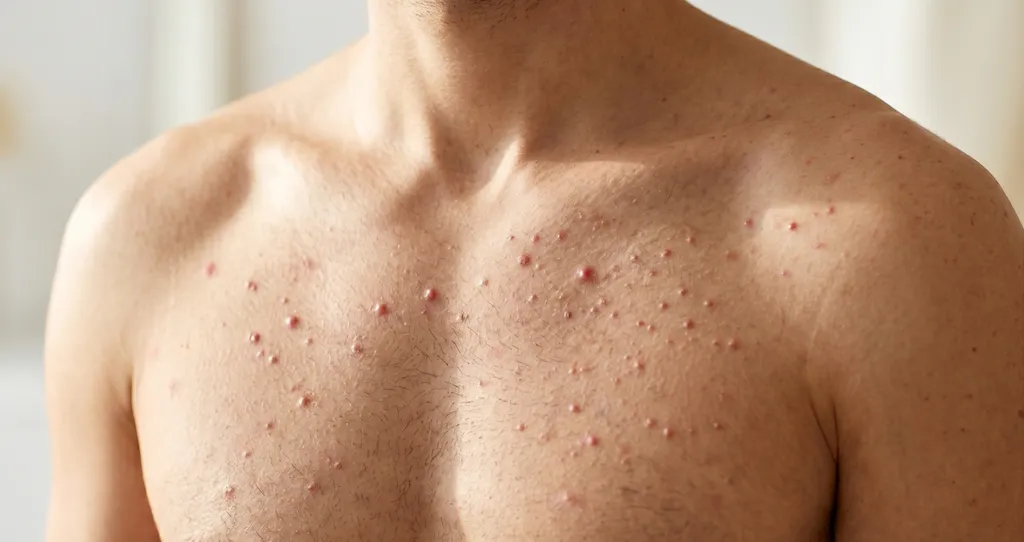
| Weeks 2–6 | Maybe a short flare of breakouts | “Many patients notice a short flare of breakouts (“purge”).” “This is normal, usually settles on its own, and should not prompt you to stop the medication.” |
| Weeks 4–8 | First visible improvement; fewer new pimples | “Existing lesions are starting to resolve, too” |
| Months 3–4 | The biggest change; few new breakouts; red marks remain | “Marks begin to fade over months to years. Dark or brown spots from previous breakouts (post-inflammatory hyperpigmentation) also start to lighten and continue to fade as inflammation settles, sometimes dramatically.” |
| Months 4–6 | Clear or nearly clear; marks keep fading | “Isotretinoin can soften fresh acne scars by reducing inflammation and remodeling tissue. However, deeper or older scars usually require separate treatments after your skin settles post-Accutane.” |
The good news is that the regimen is strong enough to continue clearing your skin: “Improvement often continues for another 1–2 months even after you stop.” according to Marcelus
Everyone moves at a slightly different pace, so compare your skin to where it was a month ago, not to someone else’s results. Red marks often take longer to fade than the breakouts themselves. If you have few new pimples but still see pink or brown spots at month 3, you’re likely right on track. For more on why dry lips show up before clear skin, see how Accutane works.
Photos make this easier to judge than the mirror, since a side-by-side of week 1 and week 8 often shows progress you’d miss day to day. With Honeydew, you can upload photos to your patient dashboard so you and your provider can see how your skin is responding over time. For some people, though, the first visible change isn’t fewer breakouts. It’s more.
Is It Normal for Acne to Get Worse First?
Yes. Some people have a short flare in the first weeks, and a mild flare usually doesn’t slow things down. MedlinePlus says it’s normal and doesn’t mean the medicine isn’t working, and Cleveland Clinic notes it should only last a short time.
How common is it? In one study of 244 patients, about 1 in 3 had some flare, and more than half of those flares were mild. Severe flares were more likely in people who started with more severe acne or more deep bumps called nodules. So if your acne was intense to begin with, a bumpy first month is more expected, not a sign that treatment is off course.
If new breakouts are deep, painful, or spreading fast, message your provider instead of waiting it out, because a strong flare can need a change in your plan. At Honeydew, you can message your Care Team anytime, and we respond 7 days a week. Our Accutane purge guide explains what’s normal and how to make it easier.
Whether you flare or not, the pace of your results comes down to a few factors, and some of them are in your hands.
What Can Affect How Fast Accutane Works?
Two people can start Accutane on the same day and reach clear skin weeks apart. Most of the difference comes from four things:
- Your dose: Higher daily doses tend to clear acne sooner, while low doses take longer but often cause fewer side effects.
- Taking it with food: Standard isotretinoin is absorbed much better with a meal - specifically high-calorie, high fat meals, so skipping food means less medicine reaches your skin.
- Missed doses: If you miss one, skip it and don’t double up; frequent gaps can add weeks.
- How severe your acne is: Deep or widespread acne, especially on the chest and back, usually takes longer to clear.
Dose is the biggest lever, and it’s a trade-off rather than a right or wrong choice. “What matters most is the total dose over time or the cumulative dose.” adds Marcelus “Not just how quickly you clear.”
A review of clinical trials found that typical daily doses produced slightly faster improvement during treatment. But, by around 24 weeks, however, the groups had similar average improvement in acne severity, and lower doses were generally better tolerated. So by about six months, both groups had substantial improvement, and the review found no clear difference in their average acne results.
You can get a rough idea of your own dose with our Accutane dose calculator.
Food is the factor people most often overlook. If you take your capsule on an empty stomach, your body absorbs less of it, and your skin gets less medicine than your provider planned for. The easiest fix is to tie your dose to a regular meal, like breakfast or dinner, so it becomes a habit.
Missed doses often come from refill hiccups, not forgetfulness. Each month, you complete a safety check-in before your refill is approved, and a delay at the pharmacy can leave you without capsules for a few days. Our care team handles prior authorizations, pharmacy communication, and refills, so paperwork is less likely to cost you days of treatment.
Once your skin clears, you might expect to stop right away. Most providers don’t, and there’s a good reason for it.
How Long Does a Full Course Last?
According to the American Academy of Dermatology, most Accutane courses run about 15 to 20 weeks. However, clinical practice and dermatology guidelines often extend treatment to roughly 24 weeks (6 months) or until you reach your target cumulative dose of 120–150 mg/kg.
It helps to remember that clearing your skin and reaching your final dose are two different milestones.
Providers usually keep you on treatment a bit past the point of full clarity, as staying on Accutane for about two additional months significantly lowers the chance of acne returning. If your skin clears around month 4, your treatment will likely finish around month 6. Low-dose plans run longer simply because each daily dose is smaller.
Dr. Marcelus often uses a piggy bank analogy to explain this:
“Think of your treatment like a piggy bank: your daily dose is each deposit, and your cumulative dose is the total savings goal. Saving $5 a day takes twice as long to reach $100 as saving $10 a day. Lower daily doses take longer to hit the same target, which is why low-dose regimens naturally stretch over a longer timeframe.”
Finally, your last dose isn’t the finish line for your results. Skin often continues to clear after you stop taking isotretinoin—which is why official guidelines recommend waiting at least two months before evaluating whether a second course is even necessary. The true gauge of your final results comes a couple of months after your last pill.
Honeydew Recommends
Because Accutane works on a delay, the hardest part is often wondering whether you’re on track. That is why Honeydew recommends monthly virtual check-ins with your care team to monitor your progress, manage side effects, and adjust your treatment as needed.
Dr. Marcelus highlights what to expect as your treatment unfolds:
- Evaluating Early Progress: “At eight weeks, I want to hear how things are going. Are you seeing fewer breakouts? Is any early flaring settling down? You don’t need to be completely clear yet - we’ll look at your progress together to decide if your dose needs tweaking.”
- Knowing When to Finish: “We consider how long your skin has been clear and how well you tolerate treatment before stopping. Becoming clear and completing your course are separate milestones. Hitting a specific cumulative dose is a guide, not an absolute rule for every patient.”
So if your skin isn’t responding as expected, your provider should connect with you to fine-tune your dose along the way.
Best of all, getting started won’t delay your care. In many cases, treatment can begin immediately without a video visit, and if a consultation is needed, you can book one within 48 hours.
And at Honeydew, your first acne consultation is free. Clear skin with our Accutane regimen starts at just $50 a month on an annual plan. In a 4-month survey of 80 Honeydew members treating their acne, over 90% reported visible, real-world results. Depending on your coverage, prescription medication can cost as little as $0 with insurance, or cap out at $50 per box ($30 per box for low doses) through an active membership—and your initial consultation is completely free.
Want to see what your personalized treatment plan looks like? You can begin your online consultation today, and a Honeydew clinical provider will map out your exact daily dosage and overall treatment target.




.webp)