Key Takeaways

A new formulation of the popular acne drug Accutane, the common brand name for isotretinoin, is entering the U.S. market. It promises fewer side effects and a gentler experience for patients. Some are calling it “topical Accutane.” More accurately known as topical isotretinoin, it is a cream that delivers the active ingredient in oral isotretinoin (Accutane) directly to your skin.
For someone who wants help with breakouts but is concerned about systemic side effects, that is an appealing possibility. It also raises a question: Can a cream deliver the lasting clear skin that makes oral isotretinoin such an effective treatment?
As Honeydew discusses here, topical isotretinoin can help control mild to moderate acne, but it cannot provide the potential for a permanent cure. That makes oral Accutane (isotretinoin) the preferred choice when persistent acne has not responded to standard treatment and your goal is lasting clearance, provided you can safely take it.
What Isotretinoin Cream Adds to Acne Treatment
The appeal of topical isotretinoin starts with where the medication goes. Applying it to affected skin offers a way to treat breakouts while limiting exposure throughout the body. Older topical isotretinoin gels showed very low absorption into the bloodstream, with side effects concentrated in the treated skin. That makes topical treatment relevant for people with milder acne who want to limit the side effects associated with systemic medication.
Although the U.S. offerings are new, topical isotretinoin has been studied before. A 1992 randomized, double-blind trial involving 77 people with mild to moderate acne found that 0.05% isotretinoin gel improved acne compared with placebo, with inflammatory lesions improving significantly by 12 weeks. The evidence supports a role in treating blackheads, whiteheads, and inflammatory breakouts.
Isotretinoin cream therefore may be a suitable option for managing milder breakouts while limiting systemic exposure. For patients looking for a cure, however, any topical solution can only go so far. Because topical treatments are not designed to deliver the medication beyond the skin, they cannot address deeper rooted problems that oral medications can. If you want a shot at a cure, the evidence favors oral isotretinoin.
When is ‘Isotretinoin Cream’ the Better Fit?
While traditional oral isotretinoin works systemically throughout the body, topical isotretinoin formulations offer a targeted alternative for managing mild-to-moderate acne.
The main advantage of a topical retinoid over an oral formulation comes down to systemic exposure. Because topical applications act directly on the skin's surface, they deliver targeted follicular renewal with a significantly lower risk of systemic side effects, such as dry lips, elevated liver enzymes, or birth defect risks associated with oral therapy. While topical treatments focus on continuous acne management rather than achieving long-term remission, the reduced risk profile positions them as a more suitable candidate for long-term maintenance.
When Oral Isotretinoin Is the Better Fit
You might have only a few breakouts at a time, but spend years trying to keep them under control. A treatment works, your skin improves, and then the acne returns. A history of persistent, hard to control breakouts can make oral isotretinoin the better fit even when your acne is mild or moderate.
Moreover, the 2024 AAD guidelines strongly recommend oral isotretinoin for acne that has failed standard treatment, is severe, causes scarring, or creates substantial emotional distress.
Reasons to consider oral isotretinoin include:
- You have used appropriate treatments consistently, but mild, moderate, or severe acne persists.
- You want the possibility of lasting remission after repeated treatment failures and can commit to the required monitoring.
- You have deep, painful nodules or cysts, or new breakouts are leaving scars.
- Acne is affecting your confidence, relationships, or willingness to participate in everyday life.
Most importantly, oral isotretinoin is the only acne medication known to induce lasting remission and can produce long-lasting clearance that may be permanent. A 2025 study of 19,907 patients found that, over an average follow-up of about two years, 77.5% had no recorded acne relapse requiring another oral acne medication, and 91.8% did not receive another isotretinoin course.
The Tradeoff Is Experiencing Side Effects, but Adjusting the Dose Can Help
The prospect of lasting clearance comes with more potential side effects than a topical treatment. Nonetheless, a lower daily dose can make oral treatment easier to tolerate.
In a randomized trial of 60 people with moderate acne, individuals treated with continuous low-dose isotretinoin experienced similar improvements to those treated with conventional doses, but side effects were more frequent in the conventional dosing group. This supports adjusting the dose to balance acne improvement with tolerability.
The 2025 study of relapse after isotretinoin adds another useful finding. Among patients who reached conventional or higher cumulative doses, a higher daily dose was not associated with better relapse outcomes. Greater cumulative exposure, the total amount taken across treatment, was associated with less relapse. A provider may therefore use a lower daily dose over a longer course to help you tolerate treatment while working toward lasting clearance.
Dose adjustment can reduce some side effects; it does not eliminate every risk or the need for monitoring. It gives you and your provider a way to address tolerability while preserving oral treatment as an option.
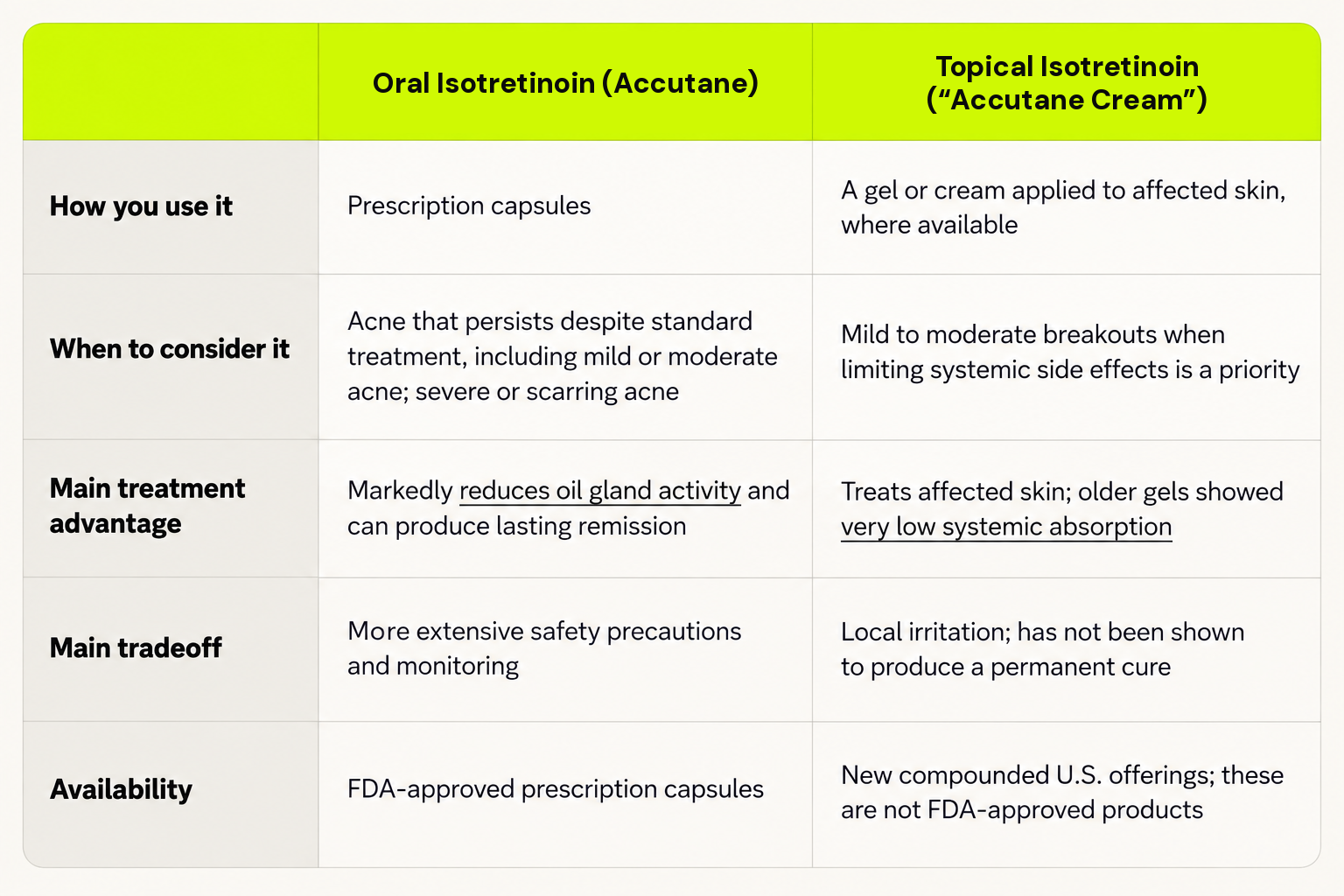
At a Glance: Oral vs. Topical Isotretinoin
The new topical options give patients another way to manage milder acne. Oral isotretinoin remains the stronger choice for persistent acne when the goal is lasting clearance, with individualized dosing helping balance its benefits and side effects.
Consider topical isotretinoin for mild to moderate acne when you want to control breakouts while limiting systemic side effects. Consider oral isotretinoin for persistent acne that has not responded to treatment when your goal is lasting remission and the possibility of a cure.
What the New Topical Options Mean for Patients
“Isotretinoin cream” adds another option to the conversation for people with mild-to-moderate acne who want to limit side effects. Its role is to help control breakouts, but it does not give patients a shot at a cure.
For acne that persists despite appropriate treatment, oral isotretinoin remains the preferred choice when lasting remission and the possibility of a cure are the priorities. That includes mild, moderate, or severe acne. Its greater potential for side effects deserves consideration, but a dose tailored to your response and tolerance can make treatment more manageable.
Whether topical or oral isotretinoin is best for you hinges on one question: what do you want out of your acne treatment plan? A few breakouts at a time can add up to years of appointments, prescriptions, and planning around your skin. If you are comfortable treating acne as a problem to manage and your acne is not severe, topical isotretinoin may be right for you. For a chance at a cure, however, there is no option other than oral isotretinoin.


Medically Reviewed by
Megan Schramm, PA-C
Physician Assistant