Key Takeaways

If you have been exploring natural acne remedies, turmeric is almost certainly on your list. This golden-yellow spice has been used in Ayurvedic and traditional medicine for thousands of years, and in recent years it has exploded in popularity as a skincare ingredient. Social media is filled with turmeric face mask tutorials, turmeric soap recommendations, and claims that this spice can clear stubborn breakouts. But when you are dealing with acne that is genuinely affecting your confidence and daily life, you need to separate the evidence from the enthusiasm.
The truth about turmeric and acne is more nuanced than most sources let on. Turmeric does contain curcumin, a compound with well-documented anti-inflammatory and antioxidant properties that are theoretically relevant to acne. Laboratory studies on curcumin look genuinely promising. But there is a significant gap between what happens in a test tube and what happens on your skin — and understanding that gap is essential before you invest time and money into turmeric-based acne treatments.
As dermatology providers who treat acne every day, we believe in being straightforward about what works, what might work, and what does not have enough evidence to recommend. Here is the full picture on turmeric and acne.
Quick Answer: Does Turmeric Help With Acne?
Possibly, but the evidence is limited. Turmeric's active compound, curcumin, has strong anti-inflammatory and antibacterial properties in laboratory studies, and a small number of clinical trials suggest it may modestly improve acne when used topically or orally. However, there are no large-scale, rigorous clinical trials confirming its effectiveness specifically for acne, and curcumin faces significant bioavailability challenges that limit how well it works in practice.
Key points:
- Curcumin has proven anti-inflammatory effects in lab studies, but poor bioavailability limits real-world results
- Turmeric soaps and face masks may have mild benefits, but are unlikely to clear moderate or persistent acne
- Turmeric does not typically cause acne, but DIY preparations can irritate skin or clog pores depending on what you mix it with
- No major dermatology guidelines recommend turmeric as a primary acne treatment
- Proven treatments like tretinoin, doxycycline, and isotretinoin are far more effective for persistent acne
What Is Turmeric and Why Is It Linked to Acne Treatment?
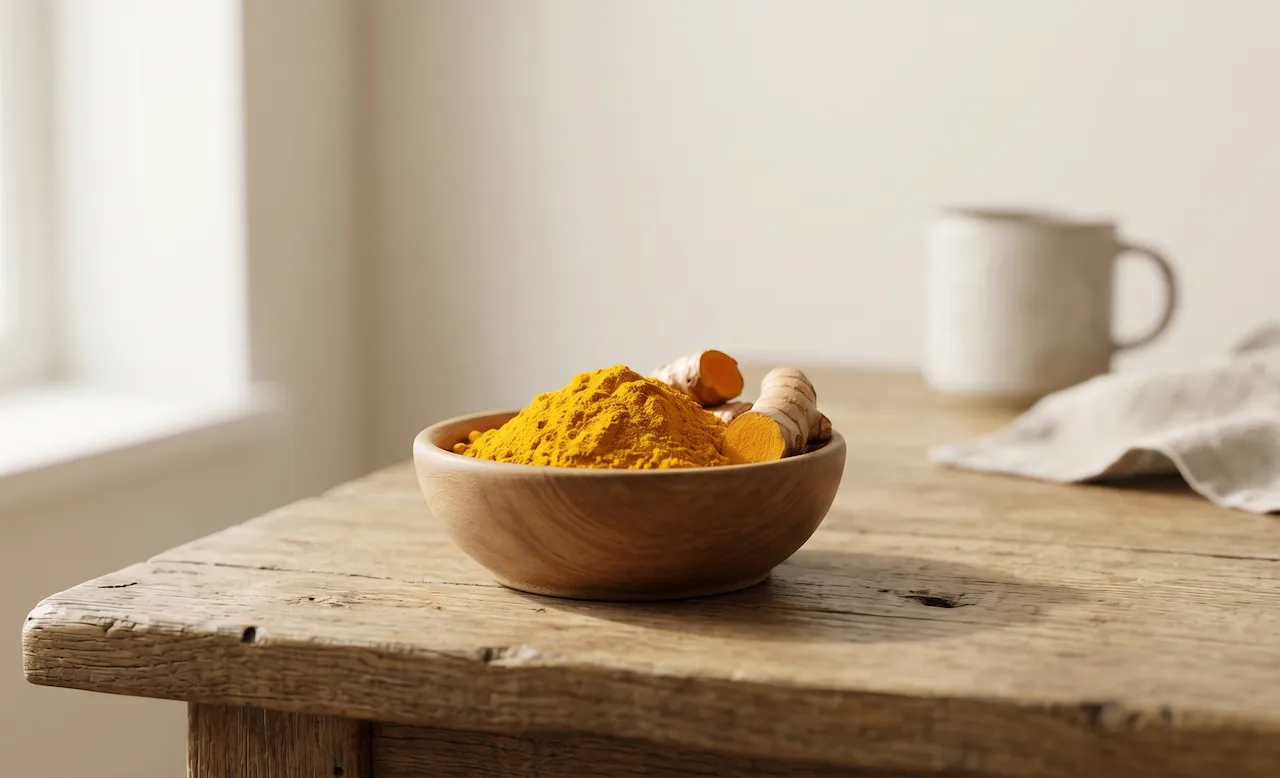
Turmeric (Curcuma longa) is a flowering plant in the ginger family, native to South Asia. The bright yellow rhizome (root) has been a staple of cooking and traditional medicine for centuries, particularly in Ayurvedic and traditional Chinese medicine, where it has been used to treat a wide range of inflammatory conditions.
The compound responsible for most of turmeric's biological activity is curcumin, a polyphenol that makes up roughly 2-8% of turmeric by weight. That is an important detail — when you use turmeric powder or a turmeric product, only a small fraction of what you are applying or consuming is actually the bioactive compound. The rest is starch, fiber, and other curcuminoids with less research behind them.
Curcumin has been the subject of extensive scientific research — over 12,000 published studies — covering its effects on inflammation, oxidative stress, cancer, metabolic disease, and more. Its appeal for acne specifically comes from its ability to modulate several of the pathways involved in breakout formation: inflammation, bacterial activity, and sebum regulation.
How Does Turmeric Fight Acne? The Science Behind Curcumin
To understand whether turmeric can help your acne, it helps to understand how curcumin interacts with the biological processes that drive breakouts.
Anti-Inflammatory Effects
Inflammation is the central engine of acne. When Cutibacterium acnes bacteria proliferate inside clogged pores, your immune system triggers an inflammatory cascade that produces the redness, swelling, and tenderness of a pimple. Curcumin is one of the most potent natural anti-inflammatory compounds studied, and it targets this process at multiple levels.
Research published in the Journal of Biological Chemistry has demonstrated that curcumin inhibits the NF-kB signaling pathway, a master regulator of inflammatory gene expression. NF-kB controls the production of inflammatory cytokines like TNF-alpha, IL-1, and IL-6 — the same molecules that drive acne inflammation. By suppressing this pathway, curcumin can theoretically reduce the inflammatory component of acne at a fundamental level.
Curcumin also inhibits cyclooxygenase-2 (COX-2) and lipoxygenase (LOX) enzymes, which produce inflammatory prostaglandins and leukotrienes. This is the same mechanism used by nonsteroidal anti-inflammatory drugs (NSAIDs) like ibuprofen, though curcumin acts through a different chemical pathway.
Antibacterial Activity
Curcumin has demonstrated broad-spectrum antibacterial activity in laboratory studies, including activity against Staphylococcus aureus and various gram-positive bacteria. A 2013 study published in Phytotherapy Research specifically tested curcumin against acne-related bacteria and found that it exhibited meaningful inhibitory effects against C. acnes at concentrations achievable in topical formulations.
Additionally, curcumin has shown the ability to disrupt bacterial biofilms — the protective structures that bacteria form on surfaces, which make them harder to eliminate. Biofilm disruption is particularly relevant to acne because C. acnes can form biofilms within pores, contributing to persistent and treatment-resistant breakouts.
Antioxidant Properties
Oxidative stress plays a role in acne pathogenesis, contributing to both the formation and inflammation of acne lesions. Curcumin is a potent antioxidant that neutralizes free radicals and enhances your body's own antioxidant enzyme systems, including superoxide dismutase (SOD), catalase, and glutathione peroxidase. By reducing oxidative damage in the skin, curcumin may help limit the inflammatory escalation that turns a minor clogged pore into a painful, inflamed lesion.
Sebum Regulation
Excess sebum (oil) production is one of the four pillars of acne formation. Early research suggests that curcumin may influence androgen signaling and sebaceous gland activity, though this area has not been as well studied as its anti-inflammatory effects. If curcumin does help regulate oil production, that would be another mechanism through which it could benefit acne-prone skin — but the evidence here remains preliminary.
What to expect: The laboratory evidence for curcumin is genuinely impressive. However, laboratory results do not always translate to real-world results on skin. The biggest challenge with curcumin — and the reason you should temper your expectations — is bioavailability. Curcumin is poorly absorbed orally and does not penetrate skin easily in its natural form, which limits how much of its anti-inflammatory power actually reaches the places it needs to go.
The Bioavailability Problem: Why Turmeric Often Underdelivers
This is the most important section of this article, because the bioavailability issue is what separates curcumin's potential from its practical reality.
Curcumin has notoriously poor bioavailability. A widely cited 2017 review published in the Journal of Medicinal Chemistry critically examined curcumin research and highlighted that curcumin is rapidly metabolized and eliminated by the body, has low aqueous solubility, and is chemically unstable at physiological pH. When you eat turmeric or take a curcumin supplement, very little of the active compound actually reaches your bloodstream or your skin in its active form.
This matters for both oral and topical use:
- Oral curcumin: Even at high doses, serum levels of curcumin remain extremely low. Without specialized delivery systems (like piperine, liposomal formulations, or nanoparticle encapsulation), most curcumin you swallow is broken down in the gut and liver before it can do anything useful.
- Topical curcumin: Curcumin is lipophilic (fat-soluble) and has a relatively large molecular weight, both of which limit its ability to penetrate the stratum corneum (the outermost skin layer) and reach the deeper layers where acne forms. Standard topical preparations — like mixing turmeric powder into a face mask — deliver very little curcumin to where it is actually needed.
This does not mean curcumin is useless. It means that how you use it matters enormously, and that a turmeric powder face mask is unlikely to deliver the same results as a carefully formulated curcumin product designed for skin penetration.
Does Turmeric Soap Help With Acne?
Turmeric soap is one of the most commonly searched turmeric products for acne, so it deserves a direct answer.
There are no clinical trials that have specifically tested turmeric soap for acne. The theoretical benefit of turmeric soap would come from curcumin's antibacterial and anti-inflammatory properties, but there are several practical issues:
- Contact time is minimal: Soap is a wash-off product. You apply it, lather, and rinse it off in 30-60 seconds. That is far too little time for curcumin to penetrate the skin or exert meaningful antibacterial effects at the pore level.
- Curcumin concentration is typically low: Most turmeric soaps do not disclose the concentration of curcumin they contain, and it is often present more for marketing and color than for therapeutic effect.
- Formulation matters: The soap base itself, the pH, and the other ingredients all affect whether any curcumin is bioavailable at all. Many turmeric soaps are alkaline, which can disrupt the skin's natural acid mantle and potentially worsen breakouts — regardless of the turmeric content.
- Staining: Turmeric is a powerful dye. Many people who use turmeric soap find it stains their skin, washcloths, and clothing yellow, which is cosmetically undesirable.
If you enjoy using turmeric soap and find it does not irritate your skin, there is no strong reason to stop. But is turmeric soap good for acne in a clinical sense? There is no evidence to support that claim. For a cleanser that actually helps with acne, a gentle cleanser formulated with salicylic acid or benzoyl peroxide has significantly more evidence behind it.
Red flag: Be cautious of turmeric soaps and skincare products that make bold acne-clearing claims without citing any clinical evidence. Turmeric is an appealing marketing ingredient, and many brands capitalize on its general health reputation without having any data to support their specific product's effectiveness for acne. If a product sounds too good to be true, it probably is.
Topical Turmeric for Acne: What the Research Shows
Beyond soap, topical turmeric products — including face masks, creams, gels, and serums — are widely promoted for acne. The clinical evidence here is limited but somewhat more encouraging than for soap products, primarily because leave-on formulations allow more contact time with the skin.
A 2016 systematic review published in Phytotherapy Research evaluated the evidence for topical herbal treatments for acne, including curcumin-based preparations. The review found that curcumin showed promise in preliminary studies, but noted that the quality and size of available trials were insufficient to draw firm conclusions.
A 2019 randomized controlled trial published in Phytotherapy Research tested a topical curcumin gel formulation on acne patients. The study found that the curcumin gel group showed statistically significant improvements in acne severity scores compared to placebo after 8 weeks. However, this was a small study, and the curcumin gel used was a specially formulated product — not a DIY turmeric paste.
Research on advanced curcumin delivery systems for skin is particularly interesting. Nanoparticle-encapsulated curcumin and liposomal curcumin formulations have shown significantly better skin penetration than standard curcumin preparations in laboratory settings. These technologies may eventually produce topical curcumin products that deliver meaningful benefits for acne — but they are not what you are getting in a jar of turmeric paste from your kitchen.
| Topical Turmeric Format | Evidence Level | Practical Considerations |
|---|---|---|
| DIY turmeric face masks | Very limited (anecdotal) | Stains skin yellow; inconsistent curcumin delivery; potential irritation |
| Turmeric soap | None (no clinical trials) | Too brief contact time; low curcumin absorption; may disrupt skin pH |
| Formulated curcumin gels/serums | Limited but promising (small studies) | Better delivery than DIY; look for products with enhanced bioavailability |
| Nano/liposomal curcumin products | Preliminary (mostly lab studies) | Most promising delivery technology; limited consumer availability |
Oral Turmeric Supplements for Acne
Taking turmeric or curcumin supplements orally is another popular approach. The idea is that systemic anti-inflammatory effects from curcumin supplementation will reduce acne from the inside out — similar to how oral anti-inflammatory medications can improve inflammatory skin conditions.
The evidence for oral curcumin specifically for acne is sparse. However, curcumin's systemic anti-inflammatory effects are well-established, and there is indirect evidence to support its potential role.
A 2016 meta-analysis published in the Journal of the American Academy of Dermatology reviewed curcumin's effects across multiple dermatological conditions and concluded that curcumin supplementation showed benefits for several inflammatory skin diseases, including psoriasis and dermatitis. The authors noted that curcumin's potential for acne was plausible given the inflammatory nature of the condition, but that specific acne trials were lacking.
If you choose to take an oral curcumin supplement, bioavailability enhancement is critical. Standard curcumin supplements have extremely low absorption. Look for formulations that include:
- Piperine (black pepper extract): Increases curcumin bioavailability by up to 2,000% by inhibiting the enzymes that break curcumin down in the gut and liver
- Liposomal delivery: Encapsulates curcumin in fat-based vesicles that improve absorption
- Nanoparticle formulations: Branded formulations like Theracurmin or CurcuWIN use nano-sized particles to dramatically improve absorption
- Curcumin phytosome (Meriva): Binds curcumin to phosphatidylcholine, improving absorption significantly
What to expect: Oral curcumin supplements are generally safe for most adults when taken at recommended doses (500-1,000 mg of curcumin per day with a bioavailability enhancer). However, they can interact with blood thinners, diabetes medications, and other drugs. If you are taking any prescription medications, check with your healthcare provider before starting curcumin supplements. Also keep in mind that even with enhanced bioavailability, the evidence for curcumin clearing acne is much weaker than for proven prescription treatments.
Does Turmeric Cause Acne?
This is a common concern, and the short answer is: turmeric itself does not cause acne. There is no evidence that curcumin triggers breakouts, increases sebum production, or clogs pores.
However, there are scenarios where turmeric use could potentially worsen acne indirectly:
- DIY face masks with comedogenic ingredients: Many turmeric face mask recipes call for mixing turmeric with coconut oil, heavy creams, or honey. Coconut oil in particular is highly comedogenic and can clog pores, leading to new breakouts — even though the turmeric itself is not the problem.
- Contact irritation: Some people experience skin irritation or contact dermatitis from topical turmeric, particularly at higher concentrations. Irritated, compromised skin is more prone to breakouts.
- Allergic reactions: While rare, allergic contact dermatitis to turmeric has been reported in the literature. An allergic reaction can produce redness, swelling, and bumps that may be mistaken for acne.
- Supplement additives: Some oral turmeric supplements contain fillers, binders, or other inactive ingredients that could theoretically trigger breakouts in sensitive individuals.
If you notice new breakouts after starting a turmeric product, the culprit is more likely a comedogenic carrier ingredient in the formulation or skin irritation from the product itself — not the turmeric. Discontinue use and see if your skin improves.
Turmeric vs. Proven Acne Treatments
Understanding where turmeric fits in the landscape of acne treatments helps you make informed decisions about your skincare routine.
| Treatment | Evidence Level | Effectiveness | Best For |
|---|---|---|---|
| Turmeric / curcumin (topical or oral) | Low | Unclear — possibly mild | Supplemental use; mild inflammation |
| Benzoyl peroxide (OTC topical) | High | Moderate | Mild to moderate inflammatory acne |
| Tretinoin (Rx topical) | High | Moderate-Strong | Comedonal and inflammatory acne |
| Doxycycline (Rx oral) | High | Strong | Moderate to severe inflammatory acne |
| Spironolactone (Rx oral) | High | Strong | Hormonal acne |
| Isotretinoin / Accutane (Rx oral) | Very High | Very Strong | Persistent acne not responding to other treatments |
The gap is significant. Treatments like tretinoin, doxycycline, and isotretinoin have been validated in dozens of large, well-designed clinical trials. Turmeric has preliminary data from small studies and strong laboratory evidence, but nothing close to the clinical validation that established acne treatments have undergone. It is reasonable to try turmeric as a complementary ingredient, but not as a replacement for treatments with a stronger evidence base — particularly if your acne is moderate, persistent, or causing scarring.
When Turmeric Is Not Enough
We understand the appeal of natural remedies. Many people prefer to start with gentler, more accessible options before moving to prescription treatments, and that is a reasonable approach for very mild breakouts. But there are clear signs that turmeric and other natural treatments are not enough for your acne:
- Your acne has not improved after 8-12 weeks of consistent use
- You have deep, painful, cystic, or nodular breakouts
- Your acne is leaving scars, pits, or persistent dark marks
- Breakouts are widespread across your face, chest, or back
- You have tried multiple over-the-counter products without meaningful improvement
- Acne is affecting your confidence, mood, or social interactions
In these situations, delaying effective treatment in favor of unproven natural remedies can lead to permanent scarring. Prescription acne treatments are effective because they target the root causes of acne — excess oil production, abnormal skin cell turnover, bacterial overgrowth, and deep inflammation — at a level that natural ingredients simply cannot match.
That does not mean you need to give up turmeric entirely. If you enjoy it as part of your routine and it is not irritating your skin, you can continue using it alongside prescription treatments — as long as your provider agrees. But your primary acne treatment strategy should be based on ingredients and medications with strong clinical evidence.
Important: Delaying effective acne treatment can lead to permanent scarring that is much harder and more expensive to treat than the acne itself. If natural remedies are not working after a few months, do not keep waiting. The sooner you start an evidence-based treatment plan, the better your outcomes will be. Learn more about our acne treatment options.
How to Use Turmeric Safely for Skin
If you want to incorporate turmeric into your skincare routine, here are some guidelines to do it safely and minimize risks.
For Topical Use
- Always patch test first: Apply a small amount to the inside of your forearm and wait 24-48 hours before using it on your face
- Avoid comedogenic carriers: If you are making a DIY mask, do not mix turmeric with coconut oil, which can clog pores. Use non-comedogenic ingredients instead
- Expect staining: Turmeric will temporarily stain your skin yellow. This fades within a few hours to a day, but avoid applying it before social events or important meetings
- Consider formulated products: Commercially formulated curcumin serums and gels are more likely to deliver meaningful amounts of curcumin than DIY preparations, and they are typically designed to minimize staining
- Use sunscreen: Apply broad-spectrum sunscreen when using any active ingredient on your skin, including turmeric
For Oral Supplements
- Choose bioavailability-enhanced formulations: Look for curcumin supplements that include piperine (BioPerine), are liposomal, or use phytosome technology
- Stick to recommended doses: 500-1,000 mg of curcumin per day is the typical range used in clinical studies
- Take with a meal: Fat-soluble curcumin absorbs better when taken with food containing healthy fats
- Check for drug interactions: Curcumin can interact with blood thinners (warfarin), diabetes medications, and other drugs. Consult your healthcare provider if you take any prescription medications
What to expect: At Honeydew, our board-certified dermatologists, nurse practitioners, and physician assistants can help you sort through what is working in your routine and what is not — including natural remedies like turmeric. We build personalized treatment plans based on your skin, your history, and what the evidence actually supports. Same-day or next-day appointments are available through our online platform.
The Bottom Line
Does turmeric help acne? The honest answer is: maybe, a little, but do not count on it. Curcumin has impressive anti-inflammatory properties in the lab, and there are theoretical reasons to believe it could benefit acne-prone skin. A small number of preliminary studies are encouraging. But the evidence gap between curcumin's laboratory potential and its real-world performance on acne is substantial, largely because of bioavailability limitations that prevent curcumin from reaching the skin in effective concentrations.
Turmeric soap, DIY turmeric masks, and basic turmeric supplements are unlikely to produce meaningful acne improvement for most people. Formulated curcumin products with enhanced bioavailability are more promising, but the data supporting them is still in its early stages. For now, turmeric is best thought of as a potential complementary ingredient — something that might offer marginal benefits alongside proven treatments, but not a standalone solution.
If your acne is persistent, moderate to severe, or leaving scars, the most important step you can take is to consult a dermatologist and start an evidence-based treatment plan. At Honeydew, we have treated over 100,000 acne cases, and we can help you move past the trial-and-error phase of natural remedies and into a treatment strategy that is built on what actually works.
.webp)

Medically Reviewed by
Joel Spitz, MD
Co-Founder & Chief Medical Officer, Board Certified Dermatologist