Key Takeaways
 Epiduo combines adapalene, a retinoid, with benzoyl peroxide in one once-daily prescription gel.
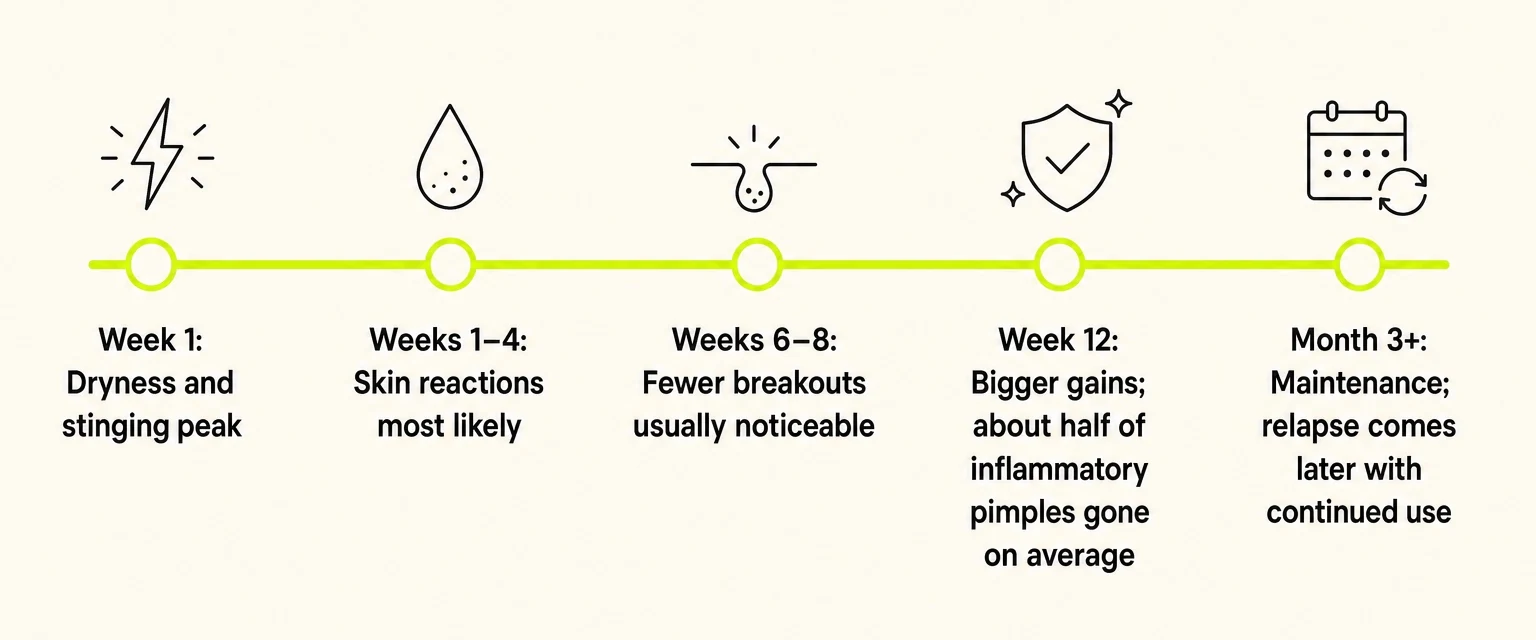
- Dryness and stinging peak in week 1, and skin reactions are most likely in the first 4 weeks.
- Fewer breakouts usually show after 6–8 weeks; clinical trials measured results at week 12.
- Applying Epiduo more than once a day won't speed results and can add irritation.
- In a 6-month trial, staying on the gel after acne improved delayed relapse compared with a plain gel.
- Epiduo Forte has three times the adapalene (0.3%) and is approved for ages 12 and up.
Week one brings Epiduo's worst irritation, but its clinical trials judged success at week 12. That leaves an awkward gap. For weeks, your skin can feel drier and look redder before it looks any clearer.
It's easy to wonder whether the gel is doing anything at all. So how long does Epiduo really take to work?
Quick Answer: How long does Epiduo take to work?
Most people see fewer breakouts after 6 to 8 weeks, with bigger gains by about three months. Skin reactions are most likely in the first four weeks, then ease. Honeydew's providers usually ask for about three months of once-daily use before changing course.
Did you know that up to fifty million people in the United States struggle with acne? For most people, this common skin condition is a minor inconvenience. However, for others, it can seriously affect their physical and mental well-being.
If you fall into this category, you may need stronger medication than over-the-counter. Epiduo is a popular prescription that's a good jumping-off point. But precisely what is it? Epiduo is a common prescription acne medication to fight moderate and sometimes severe acne. It does this with the help of two powerful ingredients known as benzoyl peroxide and adapalene. And how do you dose it? This helpful article will walk you through everything you need about Epiduo for acne treatment. That way, you can decide if it's right for you.
What is Epiduo, and How Does It Work?
Epiduo is a prescription medication in gel form applied to the skin. This medication treats acne thanks to two main active ingredients: benzoyl peroxide (2.5%) and adapalene (0.1%). Because adapalene is a retinoid, Epiduo is a retinoid-based treatment.
The Benzoyl peroxide in Epiduo helps fight off the harmful bacteria that cause acne, while adapalene helps keep your pores from getting clogged with dead skin cells and oil. Together, they help clear up existing pimples, reduce redness and inflammation, and prevent new breakouts from forming.
— Stephen Bearman, MD | Board Certified Dermatologist, Honeydew
What is Epiduo Forte Used for, and How Is It Different?
Epiduo Forte is the higher-strength version of Epiduo, used for the same acne. Some people use Epiduo and Epiduo Forte interchangeably. But these two products are different. Both of these products contain the same types of active drugs. Where they differ is their concentration of adapalene.
Regular Epiduo has 0.1% adapalene, while Epiduo Forte has 0.3% adapalene. Epiduo Forte is approved for ages 12 and up, while regular Epiduo can be used at nine.
Is Epiduo Good for Acne?
Thanks to the active benzoyl peroxide ingredient, Epiduo is good at fighting acne. Plus, adapalene can have a healing effect on existing acne you might have. The 2024 guidelines from the American Academy of Dermatology (AAD) strongly recommend both benzoyl peroxide and topical retinoids, especially when combining topicals with different mechanisms, which is good practice.
A 2024 systematic review of eight trials backs it up, finding the combination cut acne lesions by 27.5% to 70.2%.
What Type of Acne Does Epiduo Treat?
Epiduo can be used to treat multiple forms of acne vulgaris, the everyday acne of clogged pores and pimples. Specifically, it's often used for mild to moderate acne or the beginning stages of acne. Epiduo can also be used in combination with oral medications such as doxycycline for added benefit
How to Use Epiduo: Every Day or Twice a Day?
“Apply Epiduo once daily, using a thin layer over the entire acne-prone area rather than just individual pimples.” says Bearman, MD. Once you have it, the label's steps are short:
- Wash and dry first: Before you apply Epiduo, you should first wash your skin with water or a mild skin cleanser, then pat it dry.
- Use a pea-sized amount per area: Then, apply a small, pea-sized amount to each area of your face, such as the forehead, chin, and each cheek, spread in a thin film.
- Steer clear of sensitive spots: Try to avoid getting the gel near your eyes, lips, and mouth.
- Protect your clothes: Additionally, please don't get it on your clothes, or it can bleach them.
- Moisturize and wear sunscreen: A moisturizer helps with dryness, and sun exposure should be kept to a minimum.
You can start using it every night, but if you experience dryness, redness, or irritation, decrease to every other night or every third night until your skin adjusts. Gradually increase to nightly use as tolerated. Do not apply Epiduo more than once daily.
— Stephen Bearman, MD | Board Certified Dermatologist, Honeydew
Interested in using Epiduo but don't want to wait months for a dermatology appointment? Get started with Honeydew for online acne care.
Dosage of Epiduo
The average amount involves putting a small, pea-sized amount of Epiduo on each affected area of the face once every day, ideally at roughly the same time of day. Your provider will explain the specific dose of Epiduo for your needs.
Epiduo doses can be slightly complicated, though. First, the average dose doesn't include a specific amount. It just mentions a pea-sized amount spread over a thin film on your skin. Second, the quantity will be different for different people. If you have severe acne on your face and trunk, your provider might recommend using more than the average amount.
It's essential to use Epiduo once every day. However, if you miss a dose, avoid applying extra. Simply return to your usual once-daily routine.
“I always remind my patients that using more Epiduo doesn't mean faster or better results. Think of it like brushing your teeth - brushing harder or more often than necessary won't make them healthier and can actually cause irritation.” says Dr. Stephen Bearman, MD. “The same goes for Epiduo. Using it more than once a day can lead to unnecessary dryness, redness, and peeling without improving your results. The key is using it consistently, not excessively.”
How Long Does it Take for Epiduo to Work and Clear Acne?
For most people, fewer breakouts show up after at least 6 to 8 weeks of daily Epiduo gel use. However, the biggest gains won't come in until about twelve weeks after use. The specific amount of time it takes for Epiduo to work will depend on your body's reaction to it.
Some lucky people begin to see results after only a week of using the gel: in a 12-month study, lesion counts were already falling as early as week 1. Six to eight weeks is the AAD's general acne timeline, and week 12 is where Epiduo's own trials measured results.
Working doesn't mean spotless. In the two main trials on Epiduo's label, 21.5% and 30.1% of people reached clear or almost clear skin by week 12, compared with 5.6% and 11.3% on a plain gel. Inflammatory pimples fell by about 52% to 53% on average. Here's how the first months typically unfold:
| STAGE | WHAT'S HAPPENING | WHAT THE RESEARCH SHOWS |
|---|---|---|
| Week 1 | Dryness, redness, scaling, and stinging at their worst | Skin-reaction scores peaked at week 1 |
| Weeks 1–4 | Skin adjusting to the gel | Reactions most likely in this window |
| Weeks 6–8 | Fewer new breakouts start to show | AAD: at least 6 to 8 weeks |
| Week 12 | The point trials judged results | Inflammatory pimples down about 52% to 53% |
| Month 3 onward | Maintenance while skin stays clear | Relapse came far later on continued gel |
How Long Should You Use Epiduo, and When Can You Stop?
It's generally best to continue using Epiduo gel even after you see results, since it can help prevent more acne from emerging. The AAD notes that using a retinoid as maintenance can keep skin clear once acne is under control.
The clearest data on stopping comes from a 6-month maintenance trial in people whose severe acne had improved over 12 weeks. On a plain gel, a quarter of them had relapsed by day 56. On adapalene and benzoyl peroxide, that point didn't come until day 175.
When to stop or step down is usually decided with your provider once your skin has stayed clear, not on a set date.
Can Epiduo Remove Acne Scars and Dark Spots?
The jury is still out on whether Epiduo removes acne scars. Some initial studies are promising. One study found that the drug reduced the formation of new scars: over six months, the treated side of the face averaged 11.58 scars versus 13.55 on the side given a plain gel.
In a 24-week Epiduo Forte trial, the scar count fell 15.5% on the treated side of the face, while it rose 14.4% on the side given a plain gel. That being said, more research is needed before a conclusive answer can be given. Neither gel erases scars.
Dark spots are different. The flat marks a pimple can leave behind, called post-inflammatory hyperpigmentation (PIH), aren't scars. The AAD notes that a retinoid can help lighten them after acne clears.
The Side Effects of Epiduo
There are some side effects that may occur with the use of Epiduo. If you are concerned, contact your provider.
Mild Side Effects
Here are some of the more common side effects you're likely to experience when you use it. During the first month that you use Epiduo, you may notice at least one of the following symptoms:
- Red skin
- Dry skin
- Scaling
- Burning or stinging sensations
You will likely experience some mild side effects during the first month you use Epiduo. This will typically go away on its own. In some cases, you might also experience skin purging, meaning new pimples early on. Our acne purging guide explains how to tell it apart from irritation.
What to expect: The good news is that these symptoms tend to go away after the first month of using Epiduo. However, if they persist, you should see a provider. Also, protect your skin from sunlight when you wear Epiduo, and use a moisturizer for dryness.
Severe Side Effects
Serious allergic reactions have been reported with benzoyl peroxide products, so it's important to know the signs, just in case. Serious side effects that come with Epiduo include things like:
- Swelling around the eyes, lips, nose, or mouth
- Feeling faint or light-headed
- Difficult breathing
- Itching or hives
- Tightness around the throat and constriction
Red flag: These symptoms are all signs of an allergic reaction to an active ingredient within Epiduo. As such, you should stop using the gel and call 911 or go to the emergency room right away.
What If Epiduo Isn't Working After 12 Weeks?
If acne hasn't clearly improved after about 12 weeks of consistent, once-daily use, dermatology providers typically change the plan rather than wait it out. The usual next steps:
- A stronger gel: Moving from Epiduo to Epiduo Forte.
- Adding an oral medication: The AAD guidelines make a strong recommendation for oral doxycycline, which is commonly used alongside a topical like Epiduo.
- Isotretinoin: Accutane (isotretinoin) is used for persistent acne of any severity, including acne that keeps coming back or leaves scars.
“In my practice, if acne isn't improving after 8–12 weeks of consistent Epiduo use, we consider adjusting treatment. That might mean switching to Epiduo Forte, adding a short course of an oral antibiotic, or considering Accutane,” says Dr. Stephen Bearman.
Does Medicare Cover Epiduo?
It depends on your plan. Each Medicare drug plan has its own formulary, the list of drugs it covers, so Epiduo coverage varies. Private insurance, Medicaid, and Medicare prescription benefits may cover medications, depending on your plan, and we help with prior authorizations. Insurance isn't always the cheapest option, though: for some generic prescriptions, the cash price can be lower than a copay.
Honeydew Recommends
Honeydew's providers usually ask for 12 weeks of once-daily Epiduo before judging whether it works. That's the window the clinical trials used. Over those 12 weeks, that means once a day, paired with a moisturizer, and no doubling up. Just make sure you wear sunscreen every morning, as it increases sun sensitivity.
During that initial window, it is common to wonder whether the medication is actually helping or making things worse.
“I tell patients that acne can temporarily worsen during the first few weeks of Epiduo, almost like cleaning out a clogged drain,” says Dr. Stephen Bearman, MD. “Mild breakouts and dryness can be normal, but significant burning, redness, or peeling may mean irritation rather than purging. If this happens, or your acne isn't improving after 8–12 weeks, reach out so we can adjust your treatment.”
If irritation is still building after the first month, our providers adjust the routine rather than having you push through severe discomfort. If there's no clear improvement by week 12, that might mean moving to Epiduo Forte, adding an oral antibiotic like doxycycline, or discussing Accutane (isotretinoin) for stubborn or scarring breakouts. Once your skin clears, your provider will typically keep a retinoid-based topical going as maintenance, since stopping early invites a relapse.
Epiduo has limits, too: it won't erase deep, pitted scars, and milder breakouts may show a more subtle change.
Getting started with Honeydew is simple: your first consultation is completely free. Ongoing care starts at $25 a month on an annual plan, or $50 a month for Accutane management, and memberships are fully HSA/FSA eligible. Prescriptions are billed separately through your regular pharmacy, where your insurance can help cover the cost. Trusted by 30,000+ patients, our team of board-certified dermatologists, physician assistants, and nurse practitioners is here to guide your routine.
If you're a few weeks into Epiduo and wondering whether your skin is purging or just irritated, start your free consultation today to get a personalized treatment plan tailored to your skin.
References Cited
- American Academy of Dermatology Association. (2025, February 11). Skin conditions by the numbers. American Academy of Dermatology. https://www.aad.org/media/stats-numbers
- Centers for Medicare & Medicaid Services. (n.d.). What do drug plans cover? Medicare.gov. https://www.medicare.gov/health-drug-plans/part-d/what-drug-plans-cover
- Dréno, B., Bissonnette, R., Gagné-Henley, A., Barankin, B., Lynde, C., Kerrouche, N., & Tan, J. (2018). Prevention and reduction of atrophic acne scars with adapalene 0.3%/benzoyl peroxide 2.5% gel in subjects with moderate or severe facial acne: Results of a 6-month randomized, vehicle-controlled trial using intra-individual comparison. American Journal of Clinical Dermatology, 19(2), 275–286. https://doi.org/10.1007/s40257-018-0352-y
- Dreno, B., Tan, J., Rivier, M., Martel, P., & Bissonnette, R. (2017). Adapalene 0.1%/benzoyl peroxide 2.5% gel reduces the risk of atrophic scar formation in moderate inflammatory acne: A split-face randomized controlled trial. Journal of the European Academy of Dermatology and Venereology, 31(4), 737–742. https://doi.org/10.1111/jdv.14026
- Galderma Laboratories, L.P. (2022, April). EPIDUO FORTE (adapalene and benzoyl peroxide) gel 0.3%/2.5% [Package insert]. DailyMed, U.S. National Library of Medicine. https://dailymed.nlm.nih.gov/dailymed/drugInfo.cfm?setid=f4e5d381-098a-4c93-9ff0-002cae46daac
- Galderma Laboratories, L.P. (2026, June). EPIDUO (adapalene and benzoyl peroxide) gel 0.1%/2.5% [Package insert]. DailyMed, U.S. National Library of Medicine. https://dailymed.nlm.nih.gov/dailymed/drugInfo.cfm?setid=a0610f87-3b39-458a-afa3-66be1fefd1de
- Ludmann, P. (2024, June 19). Acne: Diagnosis and treatment. American Academy of Dermatology. https://www.aad.org/public/diseases/acne/derm-treat/treat
- Pariser, D. M., Westmoreland, P., Morris, A., Gold, M. H., Liu, Y., & Graeber, M. (2007). Long-term safety and efficacy of a unique fixed-dose combination gel of adapalene 0.1% and benzoyl peroxide 2.5% for the treatment of acne vulgaris. Journal of Drugs in Dermatology, 6(9), 899–905. https://pubmed.ncbi.nlm.nih.gov/17941361/
- Poulin, Y., Sanchez, N. P., Bucko, A., Fowler, J., Jarratt, M., Kempers, S., Kerrouche, N., Dhuin, J.-C., & Kunynetz, R. (2011). A 6-month maintenance therapy with adapalene-benzoyl peroxide gel prevents relapse and continuously improves efficacy among patients with severe acne vulgaris: Results of a randomized controlled trial. British Journal of Dermatology, 164(6), 1376–1382. https://doi.org/10.1111/j.1365-2133.2011.10344.x
- Reynolds, R. V., Yeung, H., Cheng, C. E., Cook-Bolden, F., Desai, S. R., Druby, K. M., Freeman, E. E., Keri, J. E., Stein Gold, L. F., Tan, J. K. L., Tollefson, M. M., Weiss, J. S., Wu, P. A., Zaenglein, A. L., Han, J. M., & Barbieri, J. S. (2024). Guidelines of care for the management of acne vulgaris. Journal of the American Academy of Dermatology, 90(5), 1006.e1–1006.e30. https://doi.org/10.1016/j.jaad.2023.12.017
- Sattar, K., Sakina, S., Mumtaz, S., Behram, F., Akbar, A., Jadoon, S. K., & Tasneem, S. (2024). Safety and efficacy of fixed-dose combination of adapalene and benzoyl peroxide in acne vulgaris treatment: A systematic review of clinical trials. Cureus, 16(9), Article e69341. https://doi.org/10.7759/cureus.69341


Medically Reviewed by
Stephen Bearman, MD
Board Certified Dermatologist