Key Takeaways

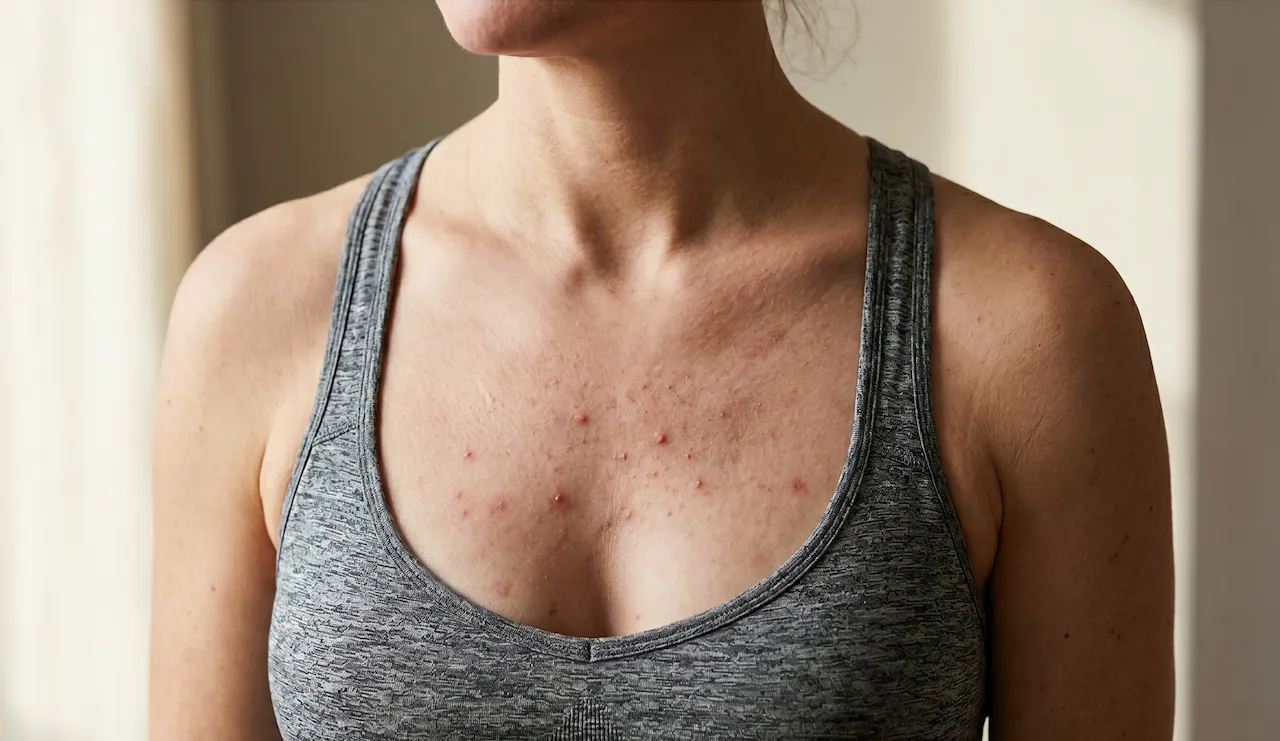
If you have ever skipped a low-cut top, changed outfits three times before leaving the house, or felt a wave of self-consciousness the moment someone's eyes drifted below your collarbone, you understand how much chest acne can weigh on your confidence. It is frustrating, and it is personal in a way that facial acne sometimes is not — because the chest is an area you may feel you should be able to hide, yet it shows up at exactly the moments you want to feel your best.
You are not alone in dealing with this. Acne affects up to 50 million people in the United States annually, and research published in the Journal of Clinical and Aesthetic Dermatology found that roughly 60% of acne sufferers develop breakouts on the trunk, including the chest. While truncal acne is often discussed in the context of men, women face their own unique set of triggers. Hormonal shifts across the menstrual cycle, the daily friction of bras and sports bras, and conditions like polycystic ovary syndrome (PCOS) all play a significant role in how and why chest acne develops in women.
The good news is that understanding these specific causes makes treatment more targeted and effective. Below, we will break down exactly what causes chest acne in females, walk through a chest-specific skincare routine, and cover the full range of treatment options — from drugstore products to prescription medications that can clear stubborn breakouts for good. For a broader look at chest acne across all genders, see our complete chest acne treatment guide.
Quick Answer: How to Get Rid of Chest Acne in Women
Identify the trigger: Chest acne in women is most often driven by hormonal fluctuations (menstrual cycles, PCOS, perimenopause) and bra-related friction. Pinpointing your primary trigger shapes everything else.
For mild breakouts: Use a benzoyl peroxide (5%) or salicylic acid (2%) body wash, wear breathable bras made of moisture-wicking fabric, and shower immediately after sweating.
For persistent or hormonal chest acne: See a dermatologist for prescription options like spironolactone, topical retinoids, or Accutane (isotretinoin).
What Causes Chest Acne in Females?
The fundamental mechanism of acne is the same regardless of gender — clogged pores, excess oil, bacteria, and inflammation. But women experience a distinct set of triggers that make the chest especially vulnerable. Understanding what causes chest acne in females specifically helps you choose the right treatment instead of wasting time on approaches that do not address the root cause.
Hormonal Fluctuations Across the Menstrual Cycle
Hormones are the most common driver of chest acne in women. In the days leading up to your period, progesterone levels rise and stimulate the sebaceous (oil) glands to produce more sebum. At the same time, the ratio of androgens to estrogen shifts in a way that further increases oil production. This cyclical surge is why many women notice chest breakouts appearing — or worsening — in the week or two before menstruation.
A study published in the Archives of Dermatology found that perimenstrual acne flares affected up to 63% of acne-prone women, with breakouts peaking in the late luteal phase of the cycle. While most research on cyclical flares focuses on the face, the same hormonal mechanisms affect the chest, which has a high concentration of androgen-sensitive sebaceous glands.
Polycystic Ovary Syndrome (PCOS)
PCOS is one of the most common endocrine disorders in women of reproductive age, affecting an estimated 6-12% of women in the United States. It is characterized by elevated androgen levels, which directly stimulate the oil glands across the face, chest, and back. Women with PCOS often experience persistent, treatment-resistant acne that does not follow the typical pattern of clearing in the mid-20s.
If your chest acne is accompanied by irregular periods, excess facial or body hair, thinning hair on the scalp, or difficulty losing weight, PCOS may be a contributing factor worth discussing with your healthcare provider.
Perimenopause and Menopause
Acne does not just affect teenagers and young adults. As estrogen levels decline during perimenopause and menopause — typically starting in the mid-40s — the relative proportion of androgens increases. This hormonal shift can trigger acne in women who have not had significant breakouts in years, or it can cause existing acne to flare. Research in the Journal of Clinical and Aesthetic Dermatology found that acne prevalence remains significant in women over 25, with 26% of women aged 31-40 and 12% of women aged 41-50 reporting active acne.
Bra Friction and Sports Bra Occlusion
This is one of the most overlooked causes of chest acne in women. Bras — especially underwire bras, push-up styles, and padded sports bras — create sustained friction, pressure, and heat against the skin. This combination of mechanical irritation and occlusion leads to a specific type of acne called acne mechanica.
Sports bras are especially problematic because they are designed to compress and hold tight during movement, trapping sweat against the chest for extended periods. If you notice that your breakouts are concentrated along the bra band line, under the underwire, or between your breasts where the bra presses hardest, acne mechanica is very likely a factor.
Pregnancy
Hormonal surges during pregnancy — particularly the rise in progesterone and androgens during the first trimester — can trigger or worsen chest acne. The increase in blood volume and changes in immune function also play a role. Pregnancy-related chest acne often catches women off guard, especially if they had clear skin before conceiving.
Skincare and Body Product Buildup
Women tend to use more products on or near the chest than men — body lotions, perfumes, sunscreens, self-tanners, and hair conditioner that rinses down during showers. Many of these products contain comedogenic (pore-clogging) ingredients like coconut oil, cocoa butter, silicones, and heavy fragrances. The daily accumulation of these products on the chest can contribute to persistent low-grade breakouts.
Stress and Cortisol
Chronic stress elevates cortisol, which in turn stimulates the adrenal glands to produce more androgens. A 2017 study in Clinical, Cosmetic and Investigational Dermatology confirmed a positive correlation between stress levels and acne severity in adult women. If your chest acne flares during high-stress periods — work deadlines, exams, major life changes — the stress-cortisol-androgen pathway is likely involved.
What to expect: Most women with chest acne have multiple overlapping triggers — for example, hormonal fluctuations combined with daily sports bra wear and a comedogenic body lotion. Addressing just one factor might improve your skin, but the best results come from tackling several at once. If you are unsure which triggers apply to you, a dermatologist can help you sort it out.
The Bra Factor: How Your Bra Affects Chest Acne
Because bra-related breakouts are so common and so specific to women, this topic deserves its own section. Understanding the mechanics helps you make simple changes that can significantly reduce chest acne.
How Bras Cause Breakouts
Bras contribute to chest acne through three mechanisms:
- Friction: Straps, underwires, and band edges rub against the skin repeatedly throughout the day, irritating the hair follicles and creating micro-inflammation that makes pores more susceptible to clogging.
- Occlusion: Tight-fitting bras press fabric against the skin, trapping sweat, oil, and bacteria underneath. The warm, moist environment accelerates bacterial growth.
- Pressure: Sustained pressure from underwires and tight bands compresses the skin and prevents normal oil flow out of the pores, increasing the likelihood of blockages.
Bra Tips for Clearer Chest Skin
| Instead of This | Try This | Why It Helps |
|---|---|---|
| Wearing the same sports bra for multiple workouts | Wash after every single wear | Removes accumulated bacteria, oil, and sweat |
| Tight, padded, or underwire bras all day | Bralettes or wireless styles when support is not critical | Reduces friction and pressure on the chest |
| Synthetic fabrics (polyester, nylon blends) | Cotton or moisture-wicking performance fabrics | Allows better airflow and pulls sweat away from skin |
| Keeping your bra on all day and evening | Removing your bra as soon as you are home | Gives skin time to breathe and reduces total friction hours |
| Sitting in a sweaty sports bra post-workout | Changing immediately and showering within 30 minutes | Prevents sweat and bacteria from sitting on skin |
Red flag: If your chest acne forms a clear pattern that matches the outline of your bra — along the band line, under the underwire, or where straps cross your chest — acne mechanica is almost certainly a major contributor. Switching to a breathable, properly fitted bra may improve your skin more than any product you apply to it.
How to Get Rid of Chest Acne: A Skincare Routine for Women
Your chest needs its own skincare approach — not just whatever runs off your face or back during your shower. The skin on your chest is thinner and more sensitive than back skin, so products that work well on the back can be too harsh here. At the same time, the chest is more prone to occlusion than the face because it is covered by clothing most of the day.
Step 1: Cleanse With an Active Ingredient Body Wash
Use a body wash containing either benzoyl peroxide (5%) or salicylic acid (2%) on your chest daily. Benzoyl peroxide is the stronger option for inflammatory acne — a study in the Journal of Drugs in Dermatology found that a 5.3% benzoyl peroxide wash significantly reduced both inflammatory and non-inflammatory body acne lesions. Salicylic acid is gentler and better for comedonal acne (blackheads and whiteheads).
Key technique: Let the wash sit on your chest for 1-2 minutes before rinsing. This contact time is what makes it effective — simply lathering and rinsing immediately does not give the active ingredients enough time to work.
Step 2: Wash Your Chest Last
This is a simple but surprisingly impactful habit. Shampoo and conditioner residue that runs down your chest leaves a film of pore-clogging ingredients — silicones, oils, and surfactants. By washing your chest as the final step in your shower, after rinsing out all hair products, you ensure that any residue gets cleaned away before you step out.
Step 3: Apply a Lightweight, Non-Comedogenic Moisturizer
Even acne-prone skin needs hydration, and over-drying your chest with active ingredients can actually trigger more oil production. Choose a lightweight, oil-free moisturizer labeled non-comedogenic. Ingredients like hyaluronic acid and niacinamide are good choices — niacinamide in particular has anti-inflammatory and sebum-regulating properties that can complement your acne treatment.
Step 4: Use Sunscreen on Exposed Chest Skin
If your chest will be exposed to the sun, apply a non-comedogenic SPF 30+ sunscreen. This is especially important if you are using retinoids or other photosensitizing treatments. Sun exposure can also darken post-acne marks, making hyperpigmentation last longer. Look for sunscreens labeled "oil-free" or "won't clog pores."
Step 5: Spot-Treat as Needed
For individual inflamed pimples, a benzoyl peroxide spot treatment (2.5%) or salicylic acid gel applied directly to the lesion can speed healing. Use a lower concentration for spot treatments on the chest than you might use on the back to avoid irritation on this thinner skin.
What to expect: Start with the body wash alone and introduce additional products one at a time, waiting a week between additions. If your chest skin gets red, dry, or flaky, scale back — you may be overdoing it. Chest skin tolerates less than you might expect. Give your routine 6-8 weeks of consistent use before judging results.
Prescription Treatments for Women's Chest Acne
If over-the-counter products and lifestyle changes are not clearing your chest acne after 2-3 months, prescription treatments can target the underlying causes more effectively. Several options are particularly well-suited for women because they address the hormonal mechanisms that drive female acne. For a full overview of treatments that work for all body acne, see our general chest acne guide.
Spironolactone
Spironolactone is an anti-androgen medication that has become one of the most effective tools for hormonal acne in women. It works by blocking androgen receptors in the skin, reducing the hormonal signals that trigger excess sebum production. A systematic review in the Journal of the American Academy of Dermatology found that spironolactone was effective for adult female acne at doses of 50-100 mg daily, with most patients seeing significant improvement within 3-6 months.
Spironolactone is a particularly strong choice if your chest acne follows a hormonal pattern — flaring before your period, worsening with stress, or developing alongside PCOS symptoms. It can be used as a standalone treatment or combined with topical treatments for faster results. For a deeper look, read our guide on how long spironolactone takes to work for acne.
Topical Retinoids
Prescription-strength retinoids like tretinoin speed up skin cell turnover and prevent the dead cell buildup that leads to clogged pores. They are effective for both comedonal and inflammatory acne on the chest. Because chest skin is more sensitive than back skin, your dermatologist may start you on a lower concentration (0.025%) and increase gradually. Tretinoin also helps fade post-acne dark marks over time — a concern for many women dealing with hyperpigmentation on the chest.
Oral Antibiotics
For moderate inflammatory chest acne, oral antibiotics like doxycycline can reduce bacteria and inflammation from the inside out. The American Academy of Dermatology's treatment guidelines recommend limiting oral antibiotic courses to 3-6 months to reduce antibiotic resistance risk. Antibiotics work well as a bridge treatment — calming active inflammation while a longer-term maintenance strategy (like spironolactone or a retinoid) takes effect. Read more about how long doxycycline takes to work for acne.
Accutane (Isotretinoin)
For persistent chest acne that has not responded to other treatments, Accutane (isotretinoin) is often the most effective path to lasting clearance. Isotretinoin works on every major acne mechanism: it dramatically reduces sebum production, shrinks oil glands, eliminates acne-causing bacteria, and normalizes skin cell turnover. A 2013 JAMA Dermatology study found that 97.4% of patients showed improvement at 12 months.
Accutane is not reserved only for the most severe cases — it is an effective option for anyone with persistent acne that keeps coming back despite other treatments, including hormonal chest acne that has not responded adequately to spironolactone or topical approaches.
Red flag: Accutane requires careful medical supervision, including regular blood tests and, for people who may become pregnant, enrollment in the iPLEDGE program with mandatory pregnancy testing. These requirements exist because isotretinoin causes severe birth defects. Working with an experienced dermatologist who specializes in Accutane management is essential. Our team at Honeydew includes board-certified dermatologists with extensive experience in Accutane treatment.
Treatment Comparison for Women's Chest Acne
| Treatment | Best For | Timeline to Results | Prescription? |
|---|---|---|---|
| Benzoyl peroxide wash | Mild-moderate inflammatory acne | 4-8 weeks | No |
| Salicylic acid wash | Blackheads, whiteheads, mild acne | 4-8 weeks | No |
| Spironolactone | Hormonal acne, cyclical breakouts, PCOS-related acne | 3-6 months | Yes |
| Topical retinoids (tretinoin) | Comedonal acne, post-acne dark marks | 8-12 weeks | Yes (Rx-strength) |
| Oral antibiotics (doxycycline) | Moderate inflammatory acne | 6-12 weeks | Yes |
| Accutane (isotretinoin) | Persistent, treatment-resistant, or cystic acne | 4-6 months | Yes |
Post-Acne Marks and Scarring on the Chest
Chest acne often leaves behind dark marks (post-inflammatory hyperpigmentation) or, in some cases, raised scars. This is a particular concern for women who want to wear open-neckline clothing without feeling self-conscious about discoloration.
Dark Marks (Hyperpigmentation)
Post-inflammatory hyperpigmentation (PIH) occurs when a healed pimple leaves behind a flat, discolored spot that can range from pink to brown to deep purple depending on your skin tone. These marks are not true scars — they are temporary, but "temporary" can mean months to over a year without treatment. To speed fading:
- Niacinamide (4-5%): Inhibits melanin transfer and reduces discoloration. A study in the Journal of Clinical and Aesthetic Dermatology confirmed its effectiveness for skin lightening and barrier support.
- Azelaic acid (15-20%): A prescription option that targets both active acne and hyperpigmentation.
- Tretinoin: Speeds cell turnover to help dark marks fade more quickly.
- Sunscreen: UV exposure darkens PIH. Protecting your chest from the sun is essential while marks are fading.
Raised Scars (Hypertrophic and Keloid)
The chest is one of the areas most prone to hypertrophic and keloid scarring — raised, thickened scars that can be itchy or tender. These scars form when the body overproduces collagen during healing. Preventing chest acne scars is far easier than treating them, which is one more reason not to pick at or squeeze chest breakouts. If you already have raised scars, a dermatologist can discuss options like silicone sheets, corticosteroid injections, or laser treatments. For more on managing acne scars, see our guide on how to get rid of acne scars.
Lifestyle Habits That Make a Difference
Treatments work best when paired with daily habits that reduce the environmental factors contributing to your breakouts. These changes are simple but consistently make a meaningful difference for women dealing with chest acne.
Daily Chest Acne Prevention Checklist for Women
- Shower and change your bra within 30 minutes of sweating
- Use a medicated body wash on your chest (benzoyl peroxide or salicylic acid)
- Wash your chest as the last step in the shower, after rinsing out conditioner
- Wear a clean bra every day — never re-wear without washing
- Choose breathable, moisture-wicking fabrics for bras and tops
- Remove your bra when you get home to let your skin breathe
- Use only non-comedogenic products on your chest (lotion, sunscreen, perfume)
- Wash sheets and pillowcases weekly
- Do not pick, pop, or squeeze chest breakouts (the chest is high-risk for scarring)
- Track your breakouts relative to your menstrual cycle to identify hormonal patterns
A Note on Diet
Diet alone does not cause acne, but emerging evidence suggests a connection between certain dietary patterns and acne severity. A 2021 review in the Journal of the American Academy of Dermatology found associations between high-glycemic diets (refined carbohydrates, sugary foods) and increased acne severity. You do not need to overhaul your entire diet, but paying attention to whether certain foods correlate with your flares — especially in combination with your cycle — can be useful information to share with your dermatologist.
When to See a Dermatologist
Self-care goes a long way for mild chest acne, but certain situations call for professional help. Consider seeing a dermatologist if:
- Over-the-counter products have not improved your chest acne after 2-3 months of consistent use
- You have deep, painful nodules or cystic lesions on your chest
- Your chest acne follows a clear hormonal pattern (cyclical flares before your period, or associated with PCOS symptoms)
- You are developing dark marks or raised scars from your breakouts
- You are not sure whether your chest bumps are acne, fungal acne, or another condition
- Your chest acne is affecting your confidence and quality of life
At Honeydew, our board-certified dermatologists, nurse practitioners, and physician assistants have treated over 100,000 acne cases, including many women dealing with hormonal and friction-related chest acne. We offer same-day or next-day video appointments, so you do not have to wait weeks for an in-person visit. Whether you need spironolactone for hormonal breakouts, a topical retinoid for post-acne marks, or Accutane for persistent acne that has not responded to other treatments, we will create a personalized plan tailored to your skin, your triggers, and your goals.
What to expect with Honeydew: During your video consultation, your provider will review photos of your chest acne, discuss your medical history — including your menstrual cycle, any hormonal conditions, and what you have already tried — and recommend a treatment plan. Many patients start seeing improvement within 4-8 weeks of beginning prescription treatment. Our membership starts at $39/month, and you can message your care team anytime with questions. Learn more about our approach on our acne treatment page.
.webp)

Medically Reviewed by
Joel Spitz, MD
Co-Founder & Chief Medical Officer, Board Certified Dermatologist