Key Takeaways

Accutane (isotretinoin) has long been considered the “nuclear option” for acne—powerful, effective, but often difficult to tolerate. While many people experience long-term clear skin, the side effects of a traditional course can be intense. This can include severe dryness, nosebleeds, muscle aches, and the need to be more careful during certain activities like drinking and spending too much time in the sun.
That’s where microdosing Accutane comes in. Interest in this lower-dose approach is climbing fast: over the past year, U.S. Google searches for “low dose Accutane” ran about 1.75 times higher than the year before, according to Google Trends. That attention from dermatologists and patients alike has made it one of the most talked-about, and misunderstood, acne treatments today. It’s not a weaker version of Accutane; it’s a smarter way to use it.
What Is Microdosing Accutane?
“Microdosing” Accutane doesn’t have one universal definition, but it generally means taking a smaller daily dose of isotretinoin than the traditional regimen.
- A standard dose is usually 0.5–1 mg per kg of body weight per day. For someone who is 130 pounds (about 60 kg), that’s about 30–80 mg daily.
- A microdose (also known as low dose) might look like 10–20 mg daily, or in some cases, just a few times per week, such as 40 mg every third day. Which schedule fits is a decision your provider makes with you, based on your weight, your acne, and how your skin responds.
Low dose vs. standard dose Accutane, explained by a Honeydew dermatology PA.
But how can a smaller dose deliver the same powerful results? The answer lies in a crucial concept that is the key to Accutane’s long-term success: the cumulative dose.
The Secret to Lasting Results: The Cumulative Dose
For most medications, a smaller dose means smaller effects. Accutane works differently. Its profound, long-term efficacy isn't determined by the strength of your daily pill, but by the cumulative dose—the total amount of medication that has built up in your system over the entire course of treatment.
It is this total dose, not your daily dose, that determines your results and, most importantly, the likelihood of staying clear for good.
The strongest evidence for this comes from a 2025 study in JAMA Dermatology by Jenny Lai, PhD, and John Barbieri, MD, MBA, of Harvard Medical School and Brigham and Women’s Hospital. The researchers followed 19,907 people for at least a year after their first isotretinoin course. The more total isotretinoin patients took, the less likely their acne was to come back, up to about 220 mg/kg. Past that point, extra medication didn’t lower relapse any further.
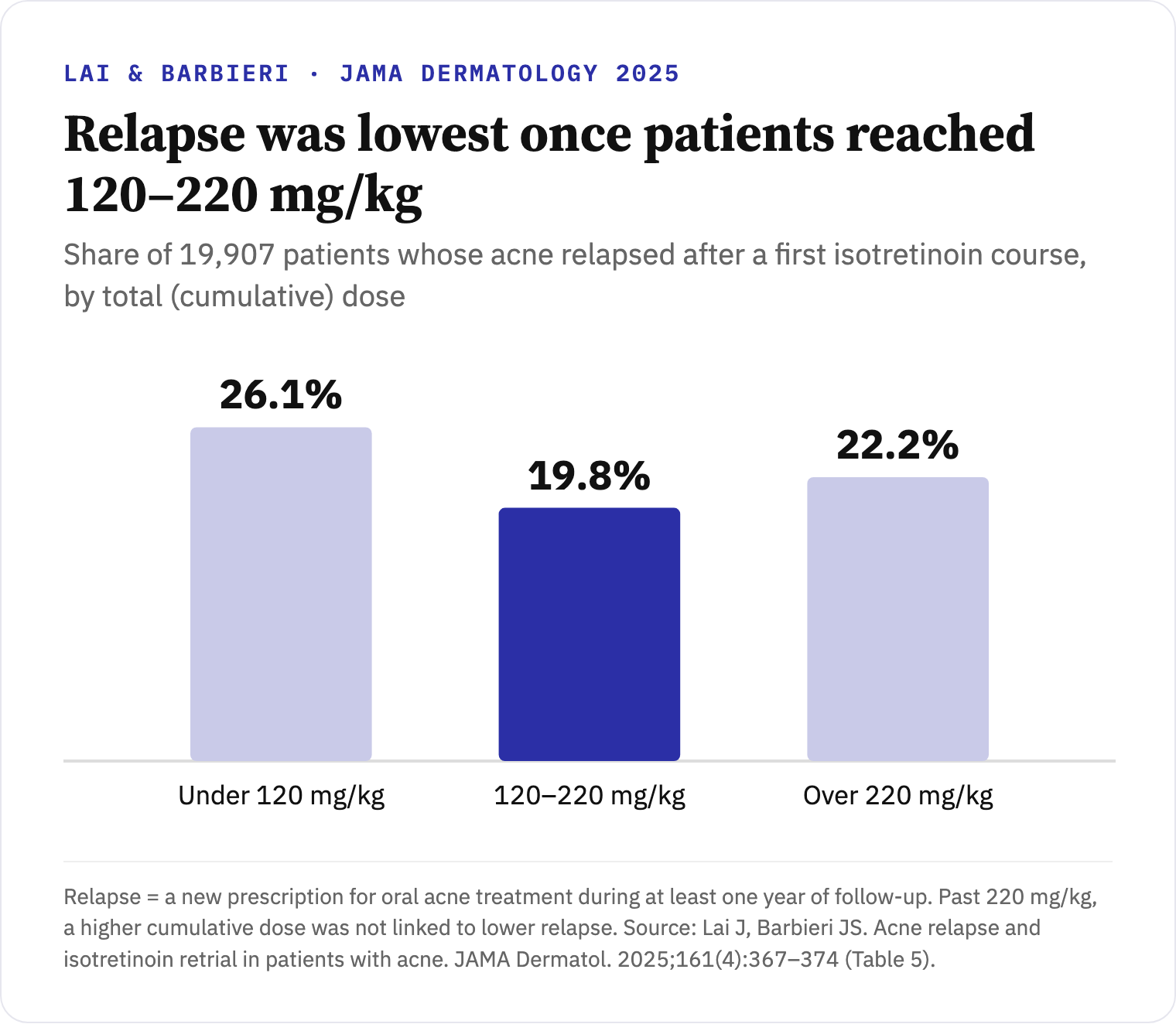
That’s the reasoning behind the commonly used target cumulative dose of 150–220 mg/kg. Both standard and low-dose regimens aim for this same target. The only difference is the timeline:
- Standard dose: Reaches the target cumulative dose in about 6–8 months.
- Microdose: Reaches the same target cumulative dose over a longer period, typically 16–24+ months.
Standard dosing gets you results faster. However, standard dosing does not get you better results. A microdosing regimen, like the ones designed by Honeydew, uses less Accutane over more time to achieve the same results. Both methods achieve the goal, but taking low dose Accutane provides a smoother, gentler, and more manageable experience for most patients.
The Lai and Barbieri study supports the idea that a bigger daily dose doesn’t buy better results. Among patients who reached at least 120 mg/kg, a higher daily dose wasn’t linked to fewer relapses, and the authors concluded that daily dosing “could be individualized to patient goals and preferences.” There’s one catch. Patients on low daily doses in the study tended to stop at a much lower cumulative dose, about 65 mg/kg on average, and they relapsed more often. A lower daily dose works when you stay on it long enough to reach your target, not as a substitute for reaching it.
Want the exact math for your body weight? Honeydew's free Accutane Cumulative Dose Calculator shows where you stand and how long you have left.
Why Microdose Instead of a Full Dose?
The primary reason is simple: a vastly improved treatment experience. By spreading the same total medication over a longer period, microdosing minimizes the peak intensity of the drug in your system. This directly translates to:
- Fewer and Milder Day-to-Day Side Effects: Many patients who can't tolerate the dryness, aches, or lab changes of a standard course find a low-dose regimen completely manageable. Lower daily doses also tend to mean a milder Accutane purge.
- Greater Sustainability: Treatment fits into your life, not the other way around. It’s a more comfortable and less disruptive path to clear skin.
- Effective for All Types: It’s a proven approach for mild, persistent acne, moderate breakouts, and even for those who have relapsed after a previous standard course.
What the Research Shows: Low Dose vs. Full Dose
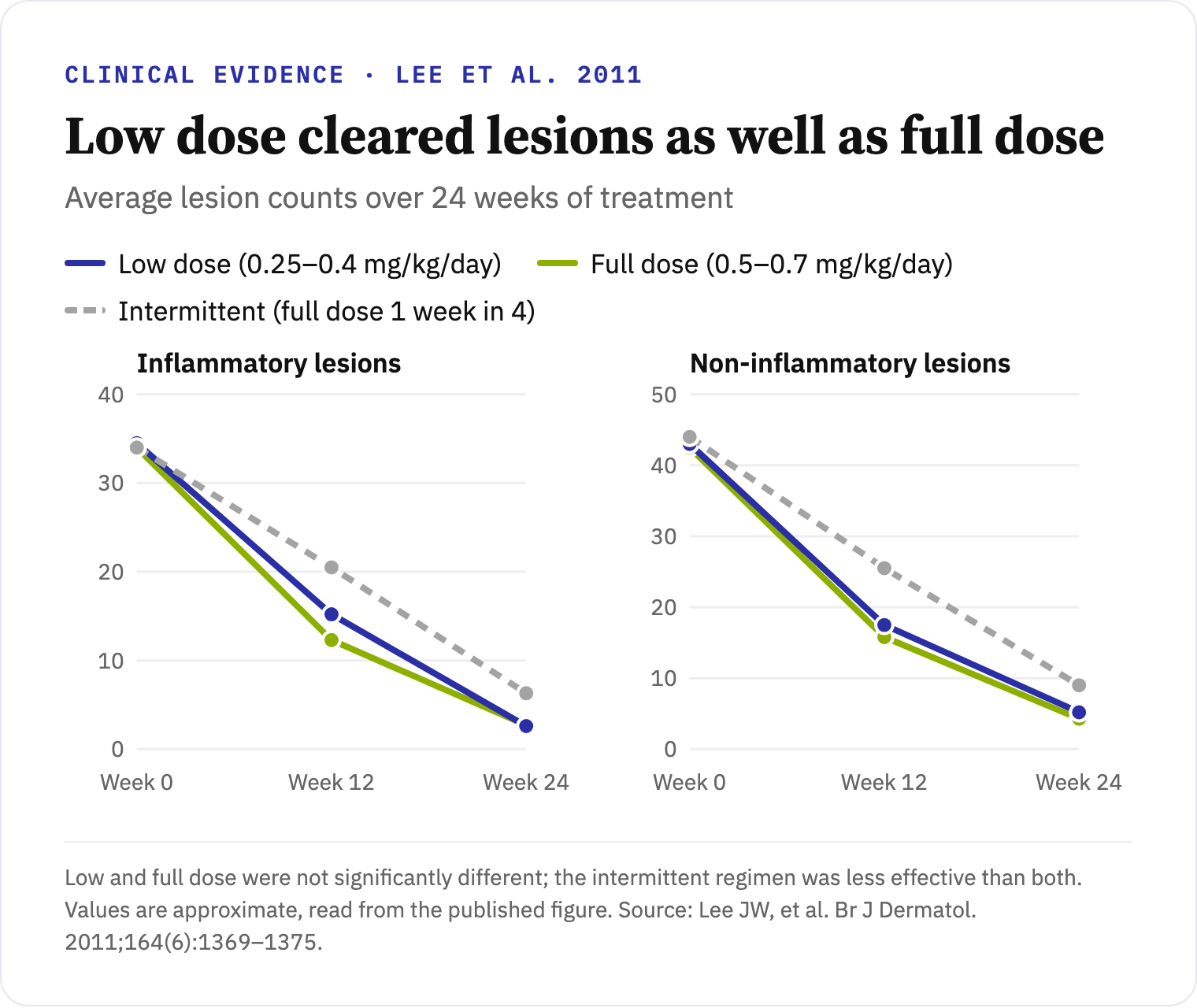
These benefits aren’t just anecdotal. The most direct comparison comes from a randomized trial published in the British Journal of Dermatology in 2011. Researchers assigned 60 people with moderate acne to one of three regimens: a full dose (0.5–0.7 mg/kg per day for 24 weeks), a low dose (0.25–0.4 mg/kg per day for 24 weeks), or an intermittent schedule (the full dose for one week out of every four).
Low dose cleared acne as well as full dose. Inflammatory and non-inflammatory lesion counts fell at nearly the same pace in both groups, with no significant difference between them. The intermittent group, which took medication only one week a month, fell behind both.
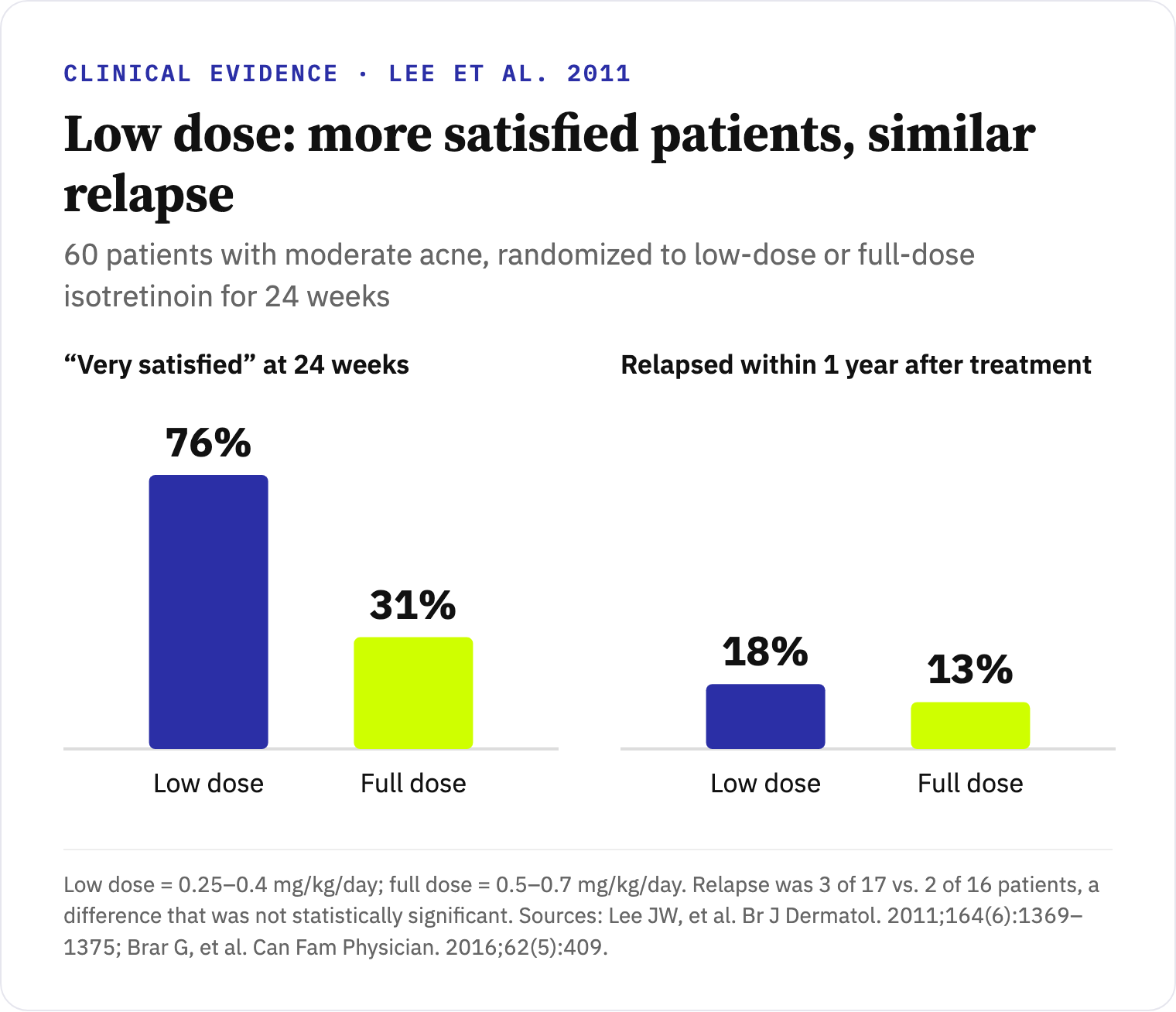
Where the groups differed was in how people felt about treatment. Side effects were more common on the full dose, and 76% of the low-dose group said they were “very satisfied” at 24 weeks, compared with 31% of the full-dose group, as summarized in a 2016 review in Canadian Family Physician. One year after treatment ended, 18% of the low-dose group had relapsed (3 of 17 people) versus 13% of the full-dose group (2 of 16), a difference that wasn’t statistically significant.
Two caveats are worth knowing. This was a small study, and its low-dose regimen (0.25–0.4 mg/kg a day for 24 weeks) isn’t the same as a Honeydew microdose plan, which your provider sets and which usually runs longer. And across studies, low-dose groups that stop early reach a lower cumulative dose, which is one reason relapse can run slightly higher.
Microdosing is not a “shortcut” or “weaker” treatment—you’ll still reach the all-important cumulative dose required for lasting results. It’s just a more modern, patient-focused way to get there.
Why microdose Accutane? A Honeydew provider explains.
What Does Microdose Accutane Cost?
A lower dose is also easier on your budget month to month. With Honeydew, low-dose Accutane costs no more than $30 per box when you pay cash, compared with $50 per box for a standard dose, and it can be as low as $0 with insurance. Accutane care starts at $50/month with an annual plan and covers your provider care, unlimited follow-ups, and iPLEDGE support; the medication itself is billed separately.
Because a microdose course runs longer, what you spend overall depends on your dose and how long it takes to reach your cumulative target. Honeydew’s free Accutane Cost Calculator estimates your monthly cost with or without insurance.
Why Honeydew Is the Leader in Cumulative Dose Therapy
At Honeydew, our entire treatment philosophy centers on the science of the cumulative dose. Unlike traditional clinics that may default to a one-size-fits-all, high-dose course, Honeydew specializes in personalized, low-dose regimens designed around your lifestyle and your skin's needs. We’ve pioneered accessible, online microdosed Accutane care that puts patient comfort and long-term success first.
Podcast clip: Eviba Carter, Chief Skincare Scientist at Honeydew, on his microdose Accutane journey.
Our board-certified dermatology providers don't just prescribe a generic low dose; they calculate your personal target cumulative dose based on your body weight. They then design a flexible, low-dose regimen that allows you to reach that goal comfortably and sustainably, ensuring you get the full, lasting benefits of Accutane.
With Honeydew, you get:
- Board-certified dermatology care focused on the science of cumulative dose therapy.
- Custom low-dose Accutane regimens tailored to your unique target.
- Convenient at-home monitoring and dedicated support throughout your entire treatment.
- Transparent pricing and nationwide access from the comfort of home.
If you’ve been curious about Accutane but hesitant because of the side effects, Honeydew makes taking Accutane safe, simple, and effective by focusing on what truly matters: the total dose.
The Bottom Line
Microdosing Accutane is a science-backed alternative to traditional dosing that makes this powerful medication accessible to more people. In head-to-head research, a low dose cleared acne as well as a full dose, with fewer side effects and far more satisfied patients. And large-scale data shows it’s the total dose you reach, not the size of your daily pill, that keeps acne from coming back. Stay on track to your cumulative target, and a gentler course can deliver the same lasting results.
Ready to take the next step? Here's how to get low-dose Accutane online.
Start your personalized Accutane regimen with Honeydew today.


Medically Reviewed by
David Futoran
Co-Founder & Chief Executive Officer