Key Takeaways

More often than not, clearing a breakout is only half the battle as dark spots and scars stick around long after the pimple itself is gone. This is supported by research published in the Journal of Clinical and Aesthetic Dermatology, up to 65% of acne patients suffer from lingering post-inflammatory hyperpigmentation or permanent scarring long after active breakouts clear.
Benzoyl peroxide (BP) is one of the most effective over-the-counter treatments for active acne—but does it actually help with acne scars? The short answer is not directly. While BP is exceptional at killing acne bacteria and clearing active breakouts, it cannot fade dark spots or repair damaged skin tissue.
Quick Answer: Does Benzoyl Peroxide Help Acne Scars?
Yes and No, Benzoyl peroxide does not directly fade dark marks or heal acne scars by itself, but it plays a vital role in prevention. Honeydew recommends pairing benzoyl peroxide with a prescription topical retinoid like tretinoin or azelaic acid, which actively fades dark spots and repairs skin texture while keeping new pimples from forming.
However, preventing new breakouts is the best way to stop future scarring. Here is what benzoyl peroxide actually does for your skin, why it falls short for existing marks, and which treatments work better to clear up what is left behind.
What Does Benzoyl Peroxide Do for Acne?
Before we address scars, it is important to understand why benzoyl peroxide is so good at what it does do. Benzoyl peroxide is an organic peroxide compound that has been used to treat acne for over 60 years. It works through three primary mechanisms:
- Antibacterial action: Benzoyl peroxide is bactericidal — it does not just slow down Cutibacterium acnes (the bacteria responsible for inflammatory acne), it actively kills it. A review published in the Journal of Clinical and Aesthetic Dermatology confirmed that benzoyl peroxide reduces C. acnes populations by up to 98% within 7 days of use.
- Comedolytic properties: BP helps break down the keratin plugs that clog pores, making it useful for both blackheads and whiteheads — though it is less potent as a comedolytic than retinoids like tretinoin.
- Anti-inflammatory effects: By eliminating bacteria and reducing the oxidative stress within clogged pores, benzoyl peroxide decreases the inflammation that drives red, swollen breakouts.
Critically, C. acnes bacteria do not develop resistance to benzoyl peroxide — unlike topical or oral antibiotics, which can lose effectiveness over time. This is why dermatologists frequently combine benzoyl peroxide with retinoids like adapalene (in products like Epiduo) or clindamycin to prevent resistance.
What to expect: Benzoyl peroxide typically starts reducing active breakouts within 1-2 weeks, with significant improvement by 4-6 weeks. “You will be excited to know that benzoyl peroxide starts killing active bacteria within 2-48 hours after your first application, making this one of the faster acting topical medications you can use.” says Natasha Micheff, a board-certified nurse practitioner specializing in dermatology. “Although, as mentioned above, visible results will take time and up to 12 weeks to fully ascertain.”
How Benzoyl Peroxide Affects Acne Scars by Type
When people say "acne scars," they usually mean one of several distinct conditions. Benzoyl peroxide interacts differently — or not at all — with each type “acne scar”.
| Scar or mark type | Appearance and cause | Benzoyl peroxide benefit | Treatments that target it |
|---|---|---|---|
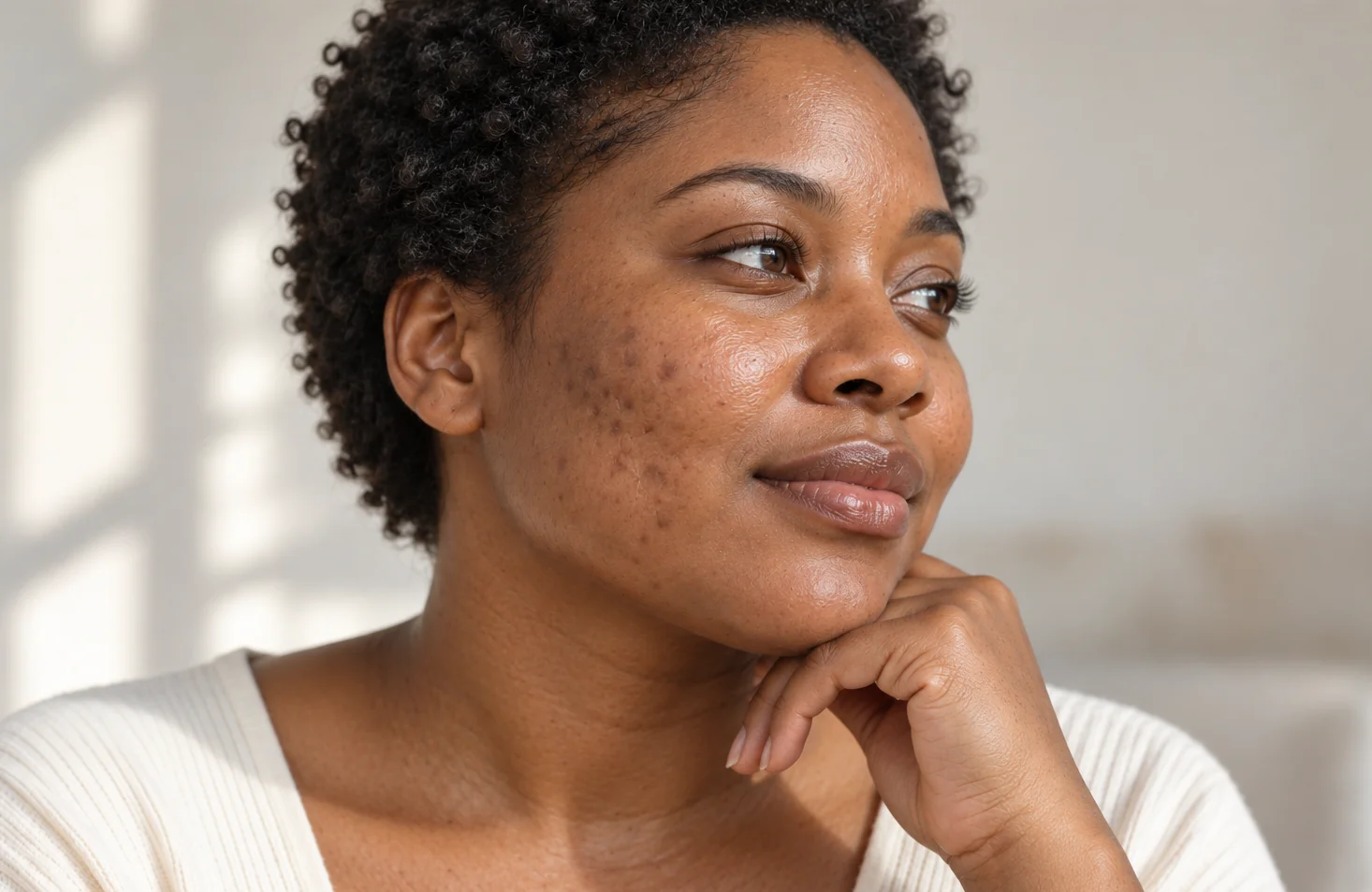
| Post-inflammatory hyperpigmentation (PIH) | Flat, dark or brown marks caused by excess melanin after inflammation. These are not true scars and are especially common in medium to darker skin tones. | Minimal benefit: BP neither inhibits melanin production nor accelerates cell turnover. Any temporary lightening is superficial and inconsistent, rather than a targeted PIH treatment; BP can also bleach fabrics. | Hydroquinone or azelaic acid to inhibit melanin production; tretinoin to accelerate cell turnover and bring pigmented cells to the surface. |
| Post-inflammatory erythema (PIE) | Flat, pink or red marks caused by dilated or damaged blood vessels beneath the skin. Common in lighter skin tones. | No significant benefit: BP does not address the underlying vascular changes. | Azelaic acid, niacinamide, or vascular lasers. |
| Atrophic scars (ice pick, boxcar, rolling) | Indented scars caused by collagen loss: deep, narrow pits (ice pick); wide, flat-bottomed depressions (boxcar); or wave-like undulations (rolling). | No benefit: BP cannot repair atrophic scarring or stimulate the collagen remodeling these scars need. | Prescription retinoids such as tretinoin, microneedling, fractional laser, or a combination. See our guide to getting rid of acne scars. |
| Hypertrophic and keloid scars | Raised scars caused by excess collagen production. | No benefit: raised scars do not respond to BP. | Corticosteroid injections, silicone sheeting, or other specialized treatments supervised by a dermatologist. |
How Benzoyl Peroxide Prevents New Acne Scars
While benzoyl peroxide cannot fade existing scars, its real value in a scar-management strategy is prevention. The logic is straightforward: the fewer breakouts you have, and the faster they resolve, the less chance any individual pimple has of leaving a permanent mark.
This matters more than it might sound. According to the American Academy of Dermatology, the risk of scarring increases with the duration and severity of inflammation. A pimple that sticks around for weeks is far more likely to scar than one that resolves in days. By killing bacteria and reducing inflammation quickly, benzoyl peroxide shortens the lifespan of individual breakouts — and that meaningfully reduces scarring risk.
This is why dermatologists often recommend continuing benzoyl peroxide even after active acne clears. Keeping C. acnes populations low prevents the cycle of breakout, inflammation, and scarring from restarting.
What to expect: If you are prone to post-inflammatory dark spots, the best strategy is a two-part approach: benzoyl peroxide to control active acne and prevent new lesions, paired with a separate treatment (like tretinoin, azelaic acid, or vitamin C serum) to fade existing marks. Your dermatologist can help you build a routine that does both without over-irritating your skin.
Choosing the Right Concentration
Benzoyl peroxide is available in concentrations ranging from 2.5% to 10%. A common assumption is that higher is better — but the evidence tells a different story.
A landmark study in the Journal of the American Academy of Dermatology compared 2.5%, 5%, and 10% benzoyl peroxide and found that all three concentrations were equally effective at reducing acne lesions. The critical difference was side effects: the 10% formulation caused significantly more dryness, redness, peeling, and irritation than the lower concentrations.
| Concentration | Effectiveness | Irritation Risk | Best For |
|---|---|---|---|
| 2.5% | High | Low | Sensitive skin, first-time users, facial use |
| 5% | High | Moderate | Most people, general acne treatment |
| 10% | High (same as 2.5%) | High | Back/body acne (thicker skin tolerates it better) |
This is important context when considering scars. Higher concentrations of benzoyl peroxide cause more irritation, and irritation itself can worsen hyperpigmentation — particularly in darker skin tones. If you are already dealing with dark spots from acne, using an unnecessarily strong benzoyl peroxide can actually make those marks darker by triggering additional inflammation. Most dermatologists recommend starting with 2.5-4 for facial use.
Red flag: If benzoyl peroxide is causing significant redness, peeling, or burning, scale back to a lower concentration or reduce how often you apply it. Excessive irritation does not mean the product is "working" — it means your skin barrier is compromised, which can slow healing and worsen post-inflammatory marks.
Can Benzoyl Peroxide Cause Acne?
This is a question we hear surprisingly often — and it is understandable. Some people start using benzoyl peroxide and feel like their skin gets worse before it gets better. There are a few reasons this can happen:
- Irritation-driven breakouts: If your skin reacts harshly to benzoyl peroxide (especially at higher concentrations), the resulting irritation can compromise your skin barrier. A damaged barrier is more vulnerable to clogging and inflammation, which can trigger new breakouts. This is not the same as a "purge" — it is your skin telling you the product is too strong or being used too often.
- Contact dermatitis: A small percentage of people are allergic to benzoyl peroxide. A study in Contact Dermatitis estimated the prevalence of benzoyl peroxide allergy at around 1-2.5%. Allergic reactions cause redness, itching, and swelling that can be mistaken for acne worsening.
- Excessive dryness: Over-drying your skin with benzoyl peroxide can trigger a compensatory increase in oil production, potentially leading to more clogged pores. This is more common with 10% formulations used multiple times daily.
If benzoyl peroxide seems to be making your acne worse after 4-6 weeks of consistent use, it is worth talking to a dermatologist about adjusting your approach — whether that means lowering the concentration, switching formulations, or trying a different treatment altogether.
What Treatments Actually Works for Acne Scars
If benzoyl peroxide is not the answer for existing scars, what is? As we mentioned above, the right treatment or medication depends entirely on the type of scarring you are dealing with. Here is a comparison of evidence-backed options:
| Treatment | Best For | How It Works | Prescription? |
|---|---|---|---|
| Tretinoin | PIH, mild texture | Accelerates cell turnover, stimulates collagen | Yes |
| Azelaic acid | PIH, PIE | Inhibits melanin production, anti-inflammatory | Rx for 15-20% |
| Vitamin C serum | PIH, brightening | Antioxidant, inhibits tyrosinase (melanin enzyme) | No (OTC) |
| Niacinamide | PIH, redness | Reduces melanin transfer, strengthens barrier | No (OTC) |
| Microneedling | Atrophic scars | Triggers collagen remodeling via micro-injuries | In-office procedure |
| Isotretinoin (Accutane) | Persistent acne causing ongoing scars | Stops acne at the source, preventing future scarring | Yes |
For most people with post-acne dark spots, a prescription retinoid like tretinoin is the single most effective topical treatment. It directly accelerates the shedding of pigmented cells while stimulating new collagen production underneath — two things benzoyl peroxide simply cannot do.
If your acne is persistent and you are developing new scars with each breakout cycle, it may be worth discussing isotretinoin (Accutane) with your dermatologist. By addressing acne at its root, isotretinoin can break the cycle of breakouts and scarring entirely. Learn more in our guide to the most effective acne treatments.
Red flag: Never combine benzoyl peroxide with tretinoin in the same application unless specifically instructed by your dermatologist. Benzoyl peroxide can oxidize and degrade tretinoin, reducing its effectiveness. If your provider prescribes both, they will typically have you apply one in the morning and the other at night — or recommend a stabilized combination product like Epiduo (adapalene + benzoyl peroxide).
Honeydew Recommends
Benzoyl peroxide is a solid first step for managing active acne, but if you are dealing with persistent dark spots, textured scarring, or acne that keeps coming back despite over-the-counter treatments, it is time to talk to a dermatologist.
"Many acne-prone patients are hesitant to add a moisturizer into their regimen, concerned that it will make their acne worse," notes Micheff. "However, dermatologists have found that correctly moisturizing your skin helps your acne medications to work better than patients that avoid moisturizing."
Depending on the acne scar type you have, a dermatologist can certainly build a perfect treatment plan for you with options that go beyond what is available at the drugstore. Such as tretinoin for hyperpigmentation, azelaic acid for stubborn dark marks, or isotretinoin (Accutane) for acne that is not responding to topical therapy. If you need guidance on whether a stronger treatment like isotretinoin makes sense, our providers can help you figure out the right path forward.


Medically Reviewed by
Natasha Micheff, NP-C
Nurse Practitioner