Key Takeaways
 Nearly 1 in 3 women with facial melasma had patches on the upper lip in a 2024 study.
- UV light, visible light, heat, hormones, and irritation from hair removal can all darken the upper lip.
- Melasma looks like blotchy patches on both sides of the lip and often skips the groove under the nose.
- Tinted sunscreens with iron oxides block visible light, and in one trial they boosted melasma fading.
- Results usually take 3 to 12 months, and melasma often returns when treatment or sun protection stops.
Quick Answer: What is a melasma mustache, and how do you treat it?
A melasma mustache is basically discoloration located below your nose and above your lip. It’s a flat, blotchy brown shadow caused by sun exposure, hormones or both. With proper protection from the sun and prescription cream, you can fade the mustache, but the fading can take months of steady use. Honeydew's providers typically prescribe a custom lightening cream (hydroquinone, tranexamic acid, and tretinoin) with daily tinted sunscreen.
What is a Melasma Mustache?
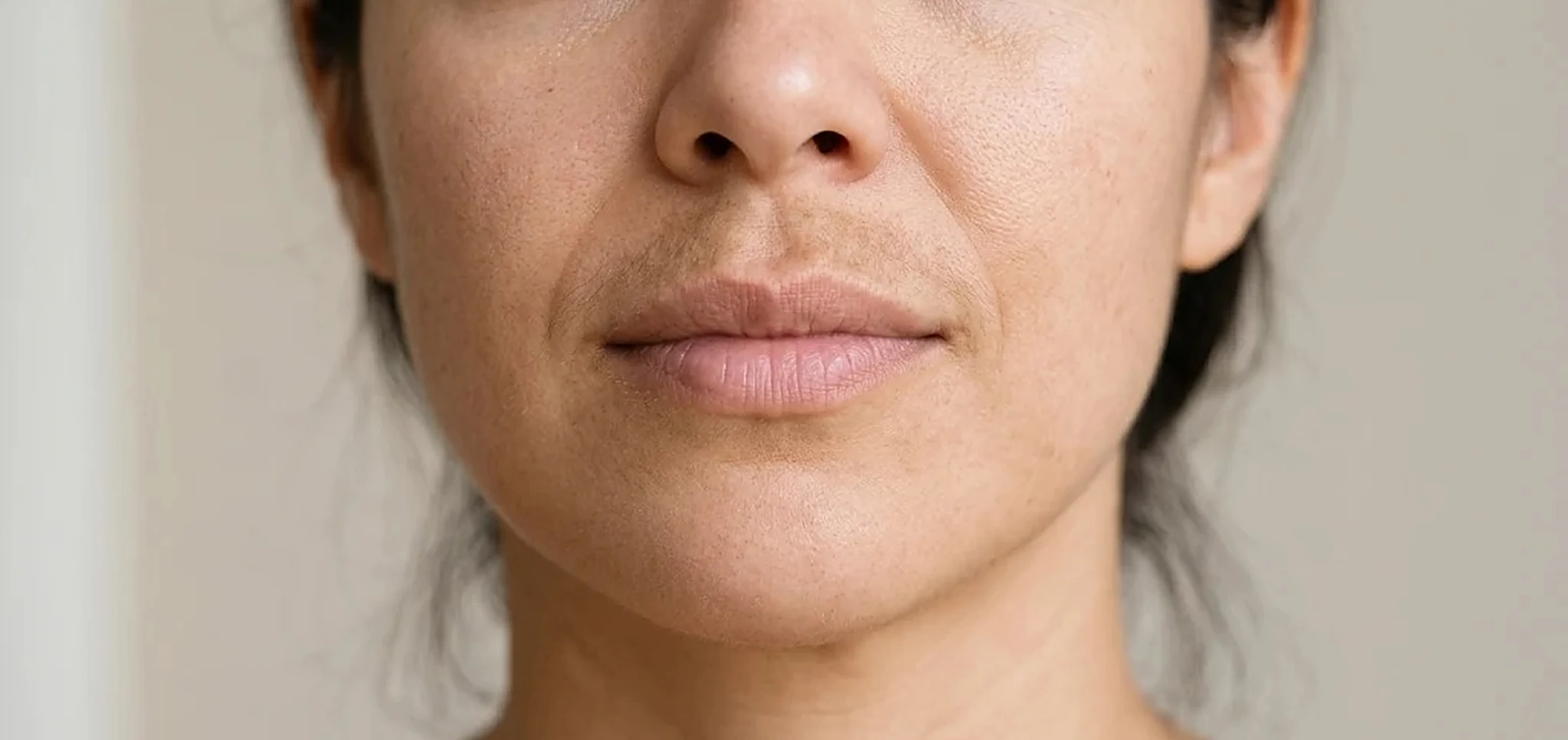
A melasma mustache is simply melasma on your upper lip - a stubborn shadow of hyperpigmentation across your upper lip that can look a lot like facial hair most often triggered by sun, heat and/or hormones rather than actual hair growth so, not an actual mustache, but it can very much resemble one.
Because a melasma mustache isn’t actually hair, it doesn’t require waxing, shaving, or bleaching. The brown shadow above your lip is pigment in the skin itself which is why it tends to show up after a sunny summer, during pregnancy, or on hormonal birth control.
The melasma mustache isn't an indication of cancer and thankfully isn't harmful, which provides some comfort when it's the first thing you see in the mirror. It's also stubborn. Hair removal won't lift it, and waxing may make it worse. Even with the right treatment, fading usually takes 3 to 12 months, and it often returns once you stop treatment or sun protection.
What works is steady and unglamorous: tinted sunscreen every day, plus a prescription lightening cream. That cream doesn't take an office visit. Our providers can prescribe it online, and your first consultation is free. Below, we cover how to tell whether your shadow is melasma and what actually fades it.
What causes a melasma mustache?
Sun and hormones are the two big triggers, which is why people also call it a sun mustache or a hormonal mustache. The upper lip is a common spot: in one study, nearly 1 in 3 women with facial melasma had patches there.
Many cases are linked to pregnancy or hormonal birth control. Some of those fade on their own after a baby is born or birth control stops, but melasma can also last for years. It also runs in families, and it's most common in women with medium to dark skin tones.
Melasma only appears on sun-exposed skin. Both UV and visible light (the light you can see) push your skin to make more pigment. And sunscreen wears off your upper lip fast, because every meal, drink, and nose wipe takes some with it. Heat makes it worse, too: in the same study, women whose skin got direct heat, like in a sauna, had more widespread melasma.
Irritation can darken melasma, whether it comes from a reaction to a skin product (contact dermatitis), a cosmetic treatment, or hair removal, and the upper lip gets a lot of hair removal. That's why harsh hair removal such as waxing is best avoided.
Is it a melasma mustache or something else?
To someone schooled in Dermatology, Melasma is easy to identify; it has a telltale look: blotchy brown patches on both sides of the lip that don't itch or hurt. Look-alikes usually trace back to something specific, like waxing, a new product, or dark hair:
- Melasma: Brown patches with irregular edges that often skip the philtrum, the vertical groove under your nose. They darken with sun, visible light, and heat.
- Post-inflammatory hyperpigmentation: Flat marks where skin was irritated or inflamed, such as after waxing, laser hair removal, or a breakout. In people with skin of color, hair removal was behind nearly as many injury-related pigment marks as lasers in one study. Our guide to acne dark spots covers this type.
- Pigmented contact dermatitis: A reaction to cosmetic products or perfume that gradually darkens the face and neck.
- Hair shadow: Dark hairs or stubble that read as a patch from a distance. Up close you can see individual hairs, and the patch disappears right after hair removal.
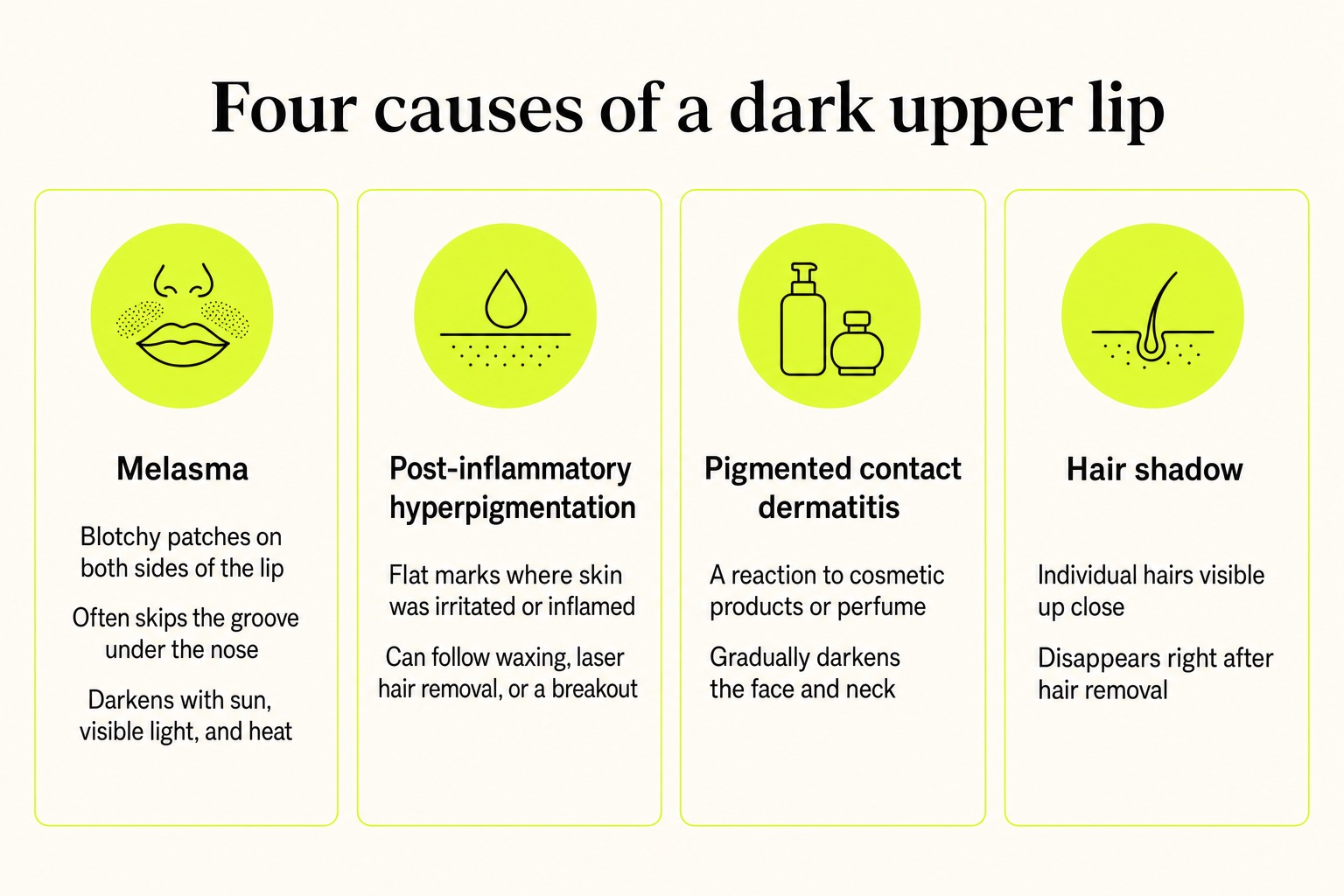
If you can't tell which one you have, our providers can usually sort it out from a few photos of your upper lip.
“Knowing the story of when and potentially how the spots started helps us figure out the cause, but melasma has a pretty distinct look to it,” says Elizabeth Cooper, DNP.
Red flag: A spot that's raised, rough, bleeding, growing, or on one side only isn't typical melasma. Have a dermatology provider check it promptly rather than treating it as a pigment problem.
What treatments fade a melasma mustache?
Daily sun protection is the foundation, and the kind matters: a sunscreen that blocks visible light as well as UV worked better than a UV-only one in people who were also using hydroquinone. Tinted sunscreens get their color from iron oxides, which block visible light, so iron oxides are the ingredient to look for on the label. “Tinted sunscreens are key because they are able to block more types of light, specifically visible light, that can worsen melasma,” recommends Elizabeth Cooper, a Nurse Practitioner with a focus on Dermatology. “Go for SPF 30+, ideally SPF 50 if you can. And remember to reapply.”
On top of that, dermatologists often can prescribe a Melasma cream. The two standard creams are hydroquinone, a skin lightener, and a “triple cream.” The triple cream adds tretinoin, a retinoid that speeds up skin cell turnover, and a steroid that calms inflammation.
Two other options come as creams. Tranexamic acid (TXA) is a medicine that stops blood clots from breaking down, and in studies it has also reduced melasma patches. Azelaic acid is the one to know about if you're pregnant or breastfeeding. The main prescription creams compare like this:
| CREAM | HOW IT HELPS | GOOD TO KNOW |
|---|---|---|
| Hydroquinone | Lightens the patch, and it's the base of the triple cream | Prescription-only in the U.S. |
| Triple-combination cream | Adds tretinoin and a steroid to hydroquinone, which help even out skin tone | FDA-approved for short-term treatment of moderate to severe facial melasma; the label says it isn't meant for maintenance |
| Tranexamic acid cream | Did about as well as hydroquinone in some trials | Works less well than the pill or injections, covered below |
| Azelaic acid 20% | Cut melasma severity by about 50% after 8 weeks of twice-daily use | Considered safe during pregnancy and breastfeeding; hydroquinone and tretinoin shouldn't be used during pregnancy |
What to expect: Change is gradual, so photos taken in the same light every few weeks show progress better than the mirror does. Mild redness, peeling, or burning is common with the triple cream, and brief redness or mild burning doesn't by itself mean treatment has to stop. Irritation that lasts or gets severe is worth reporting, since irritation can darken melasma.
“Irritation can look like stinging, burning, redness, and/or peeling skin,” says Elizabeth Cooper, DNP.
Red flag: Long-term hydroquinone rarely causes exogenous ochronosis, a slow blue-black darkening of the skin. If the patch turns bluish or darker during treatment, tell your provider. “This is why we cycle hydroquinone, typically with a few months on and a few months off,” advises Cooper.
How much does treatment cost?
Unfortunately, most insurers don't cover melasma treatment, since it isn't considered medically necessary, so plan on paying cash. Made for melasma, Tri-Luma lists at about $334 for a 30-gram tube at pharmacies nationwide—and there’s no generic. DewRx, Honeydew's custom melasma cream, is compounded, meaning a licensed pharmacy mixes it specifically for you. It costs a fraction of the retail brand-name price with medication included, and the formula is HSA/FSA eligible.
What if creams and sunscreen aren't enough?
If creams and sunscreen haven't worked, the next step may be TXA, usually as a pill and sometimes as injections. Of the three TXA forms (pill, injections, and the cream above), the pill works best. TXA's side effects include stomach upset, skin irritation, and menstrual changes.
Oral TXA is usually taken for 2 to 4 months. It's prescribed off-label for melasma, meaning the FDA hasn't approved it for that use. Because TXA changes how blood clots, it isn't recommended if you've had blood clots or a stroke, take blood thinners, are pregnant, or have cancer or kidney, heart, or lung disease.
Peels and lasers are done in a dermatologist's office, and for melasma both carry a real risk of backfiring. Peels can leave new dark patches, especially on darker skin. The heat from lasers can trigger new pigment or cause rebound darkening, when the patch comes back darker than before.
How do you keep a melasma mustache from coming back?
Melasma is a chronic condition with no cure, and it often comes back after successful treatment, especially with summer sun.
“In the first 3 to 6 months, the patches usually start to lighten and their edges become softer and less defined,” says Cooper. “After about 6 months, you’ll typically see more noticeable progress and begin moving into the maintenance phase.”
So once the patch fades, dermatologists plan maintenance care: it often means cycling off hydroquinone and switching to options such as tretinoin, with daily sun protection continuing.
Unlike hydroquinone, which is only used short term, maintenance treatments are ones you can use long term. These usually include a topical retinoid like tretinoin, tranexamic acid (TXA), or other gentle brightening ingredients. Diligent daily sun protection is just as important as any of these.
A few everyday habits help:
- Tinted sunscreen every day: Reapply after meals and drinks.
- Gentler hair removal: Threading causes little irritation, so it's an option for sensitive skin. Frequent shaving and hair-removal creams can irritate, and laser hair removal can cause dark spots.
- Gentle skin care: Choose fragrance-free products, and skip any that burn or sting.
- Less heat: Go easy on saunas and other direct heat.
Honeydew Recommends
Because melasma tends to come back, Honeydew's providers treat a melasma mustache in two phases. In phase one, DewRx, a cream that combines hydroquinone, tranexamic acid, and tretinoin, is used alongside a daily tinted sunscreen with iron oxides. In phase two, once the patch fades, they step you down to a lighter maintenance formula instead of stopping treatment cold.
“Don’t be discouraged by setbacks,” encourages Elizabeth Cooper, DNP. “Progress isn’t a straight line, and things like sun exposure and hormone changes can cause some ups and downs along the way.”
This plan fits most people with blotchy patches on both sides of the upper lip. If you're pregnant, trying to conceive, or breastfeeding, our providers build a pregnancy-safe formula instead, usually with azelaic acid.
Our providers have treated 100k+ dermatology cases online. Our care is prescription-based, so we don't offer peels or lasers, and any spot that doesn't look like typical melasma needs an in-person exam. Start your online consultation, and a provider will tell you whether it's melasma and build your formula.
References Cited
- de Abreu, A. F. T., Dias, M. O., Barbosa, M. M. C., de Amorim, R. P., Miot, H. A., & Espósito, A. C. C. (2024). Factors associated with facial melasma severity in Brazilian women: An internet-based survey. Anais Brasileiros de Dermatologia, 99(6), 918–922. https://doi.org/10.1016/j.abd.2023.12.008
- American Academy of Dermatology. (2023, September 7). 6 ways to remove unwanted hair. https://www.aad.org/public/everyday-care/hair-scalp-care/hair/remove-unwanted-hair
- Calacattawi, R., Alshahrani, M., Aleid, M., Aleid, F., Basamih, K., Alsugair, G., Alqahtani, R., AlKhabbaz, N., Algaidi, Y., Alrakayan, L., Almohanna, A., Madkhali, A., Aljohani, S., & Alotibi, N. (2024). Tranexamic acid as a therapeutic option for melasma management: Meta-analysis and systematic review of randomized controlled trials. Journal of Dermatological Treatment, 35(1), Article 2361106. https://doi.org/10.1080/09546634.2024.2361106
- Cassiano, D. P., Espósito, A. C. C., da Silva, C. N., Lima, P. B., Dias, J. A. F., Hassun, K., Miot, L. D. B., Miot, H. A., & Bagatin, E. (2022). Update on melasma—Part II: Treatment. Dermatology and Therapy, 12(9), 1989–2012. https://doi.org/10.1007/s13555-022-00780-4
- Castanedo-Cazares, J. P., Hernandez-Blanco, D., Carlos-Ortega, B., Fuentes-Ahumada, C., & Torres-Álvarez, B. (2014). Near-visible light and UV photoprotection in the treatment of melasma: A double-blind randomized trial. Photodermatology, Photoimmunology & Photomedicine, 30(1), 35–42. https://doi.org/10.1111/phpp.12086
- Espósito, A. C. C., Cassiano, D. P., da Silva, C. N., Lima, P. B., Dias, J. A. F., Hassun, K., Bagatin, E., Miot, L. D. B., & Miot, H. A. (2022). Update on melasma—Part I: Pathogenesis. Dermatology and Therapy, 12(9), 1967–1988. https://doi.org/10.1007/s13555-022-00779-x
- Galderma Laboratories, L.P. (2023, February). TRI-LUMA (fluocinolone acetonide, hydroquinone, and tretinoin) cream [Package insert]. DailyMed, U.S. National Library of Medicine. https://dailymed.nlm.nih.gov/dailymed/drugInfo.cfm?setid=a35fa709-5eb5-4429-b38f-f1e0019bf0ee
- Gan, C., & Rodrigues, M. (2024). An update on new and existing treatments for the management of melasma. American Journal of Clinical Dermatology, 25(5), 717–733. https://doi.org/10.1007/s40257-024-00863-2
- Ludmann, P. (2022a, February 15). Melasma: Diagnosis and treatment. American Academy of Dermatology. https://www.aad.org/public/diseases/a-z/melasma-treatment
- Ludmann, P. (2022b, February 15). Melasma: Overview. American Academy of Dermatology. https://www.aad.org/public/diseases/a-z/melasma-overview
- Mar, K., Khalid, B., Maazi, M., Ahmed, R., Wang, O. J. (E.), & Khosravi-Hafshejani, T. (2024). Treatment of post-inflammatory hyperpigmentation in skin of colour: A systematic review. Journal of Cutaneous Medicine and Surgery, 28(5), 473–480. https://doi.org/10.1177/12034754241265716
- Oakley, A., Doolan, B. J., & Gupta, M. (2025, December). Melasma (facial pigmentation). DermNet. https://dermnetnz.org/topics/melasma
- Salamon, M. (2023, March 1). A mask that's hard to shed. Harvard Health Publishing. https://www.harvardhealth.org/diseases-and-conditions/a-mask-thats-hard-to-shed
- SingleCare. (2026, November 10). Tri-Luma coupons & prices. https://www.singlecare.com/prescription/tri-luma
- Xu, L., Huang, Q., Wu, T., & Mu, Y. (2023). Research advances in the treatment of Riehl's melanosis. Clinical, Cosmetic and Investigational Dermatology, 16, 1181–1189. https://doi.org/10.2147/CCID.S403090


Medically Reviewed by
Elizabeth Cooper, DNP
Nurse Practitioner