Key Takeaways
 Acne can begin to clear with proven ingredients over time, about 12 weeks of consistency.
- Most acne treatments take at least 6 to 8 weeks to reduce breakouts and can take up to 3 months to show results.
- Among OTC options, benzoyl peroxide and adapalene have the strongest guideline support.
- Combining acne ingredients that work in different ways is a good practice statement in the AAD guidelines.
Acne is the most common skin condition in the United States, and one of the biggest reasons people stay stuck in a cycle of flare-ups is treating individual pimples on the surface instead of preventing clogged pores and inflammation before they start.
So rather than chasing an overnight cure to 100% get rid of all your acne (and fast), the most proven way to clear your skin is focusing on steady, measurable reduction over time.
That’s why targeted, multi-ingredient routines consistently outperform one-off spot fixes. In pivotal clinical trials for moderate-to-severe acne, about half of participants got clear or almost clear in 12 weeks on a single prescription gel, compared to just 20% to 25% on a plain gel. The difference wasn't a miracle ingredient. It was three proven ingredients combined into one gel, given steady time to work.
Most acne advice hands you a random list of tips instead of a step-by-step plan. So what actually brings your breakouts down, and in what order?
Quick Answer: How do I reduce my acne?
The most-effective way to decrease the amount of acne you have is to use benzoyl peroxide or a retinoid every day for about three months, and step up if breakouts persist. Most treatments need that long and switching sooner can add irritation. Honeydew's providers usually recommend starting with a prescription retinoid plus benzoyl peroxide.
Here's the order dermatology providers generally follow: the habits that help, the drugstore ingredients worth trying, how long to give them, and when prescription care makes sense.
Which everyday habits actually help reduce acne?
A few daily habits keep you from making breakouts worse, but none of them unclogs pores on its own. These are the ones with real support behind them:
- Wash gently, twice a day at most: The American Academy of Dermatology (AAD) advises washing up to twice daily and after sweating. Use your fingertips, since washcloths and scrubbers can irritate your skin.
- Keep your hands off: Picking or squeezing slows healing and raises your risk of scars and dark spots.
- Wear sunscreen every day: Choose a broad-spectrum SPF 30 or higher labeled "non-comedogenic," meaning it won't clog pores. Dark marks can follow even mild acne, show up more often in medium to deep skin tones, and get darker with sun exposure.
- Treat diet and stress as helpers, not fixes: A 2025 meta-analysis linked Mediterranean-style eating to less severe acne, but not to fewer people getting it, and it rated the evidence as low quality. Stress can make breakouts worse too: in a 2023 Ukrainian study, 51% of acne patients said their acne flared during the war, though that was self-reported.
- Stick with it: As we mentioned above, most acne treatments take 6 to 12 weeks to show full results, and swapping products every few days resets your progress while irritating your skin barrier. Give one steady routine time to work before deciding whether to adjust.
“In my practice, many patients have tried multiple over the counter acne products, but often jump from product to product too frequently or use several active ingredients at once, leading to irritation. I compare acne treatments to an exercise routine, consistency is key, and results take time!”
— Jessica Cheng | Nurse Practitioner, Honeydew
One angry pimple before a big day is a different job with different tools, and our guide to treating a single pimple covers it. Habits keep you from adding fuel. To actually reduce breakouts, you need an ingredient that works on what's causing them.
Which over-the-counter products are worth trying first?
Benzoyl peroxide and adapalene, a retinoid, have the strongest evidence of anything you can buy without a prescription. The 2024 AAD guidelines give benzoyl peroxide and topical retinoids a strong recommendation. Salicylic acid and azelaic acid get a weaker, conditional one.
Here's how the four most common first-step ingredients compare, using descriptions from the AAD's treatment guide:
| INGREDIENT | WHAT IT DOES | GUIDELINE SUPPORT | GOOD TO KNOW |
|---|---|---|---|
| Benzoyl peroxide | Reduces acne-causing bacteria on the skin | Strong | Can bleach towels, pillowcases, and dyed clothes |
| Adapalene (a retinoid) | Clears pores; treats blackheads, whiteheads, and some pimples | Strong | Once a day; acne may look worse before it improves |
| Salicylic acid | Opens clogged pores and exfoliates the skin | Conditional | Weaker evidence than the two above |
| Azelaic acid | Opens clogged pores and calms inflammation | Conditional | Weaker evidence than the two above |
Because they work on different causes of acne, benzoyl peroxide and adapalene are often used together. Combining ingredients with different mechanisms is one of the guideline's good practice statements, and some prescription gels put both in one tube. Our adapalene guide and benzoyl peroxide guide walk through how each one works.
A few label tips make the pair easier to live with. Benzoyl peroxide can bleach hair and fabric, so white towels and pillowcases save a lot of grief. Its label suggests starting once a day and, if your skin gets irritated, using only one acne product at a time. Adapalene goes on as a thin layer once a day, and applying more than directed won't speed results, only irritation. The hardest part comes next: leaving them alone long enough to work.
How long should you give a treatment before switching?
Plan on about 12 weeks. Most acne treatments take at least 6 to 8 weeks before breakouts start to drop, and adapalene's label says results can take up to 3 months. The trials behind newer prescriptions, like the gel above and clascoterone cream, measure success at 12 weeks too.
The usual stepped approach, and when each step is typically judged, looks like this:
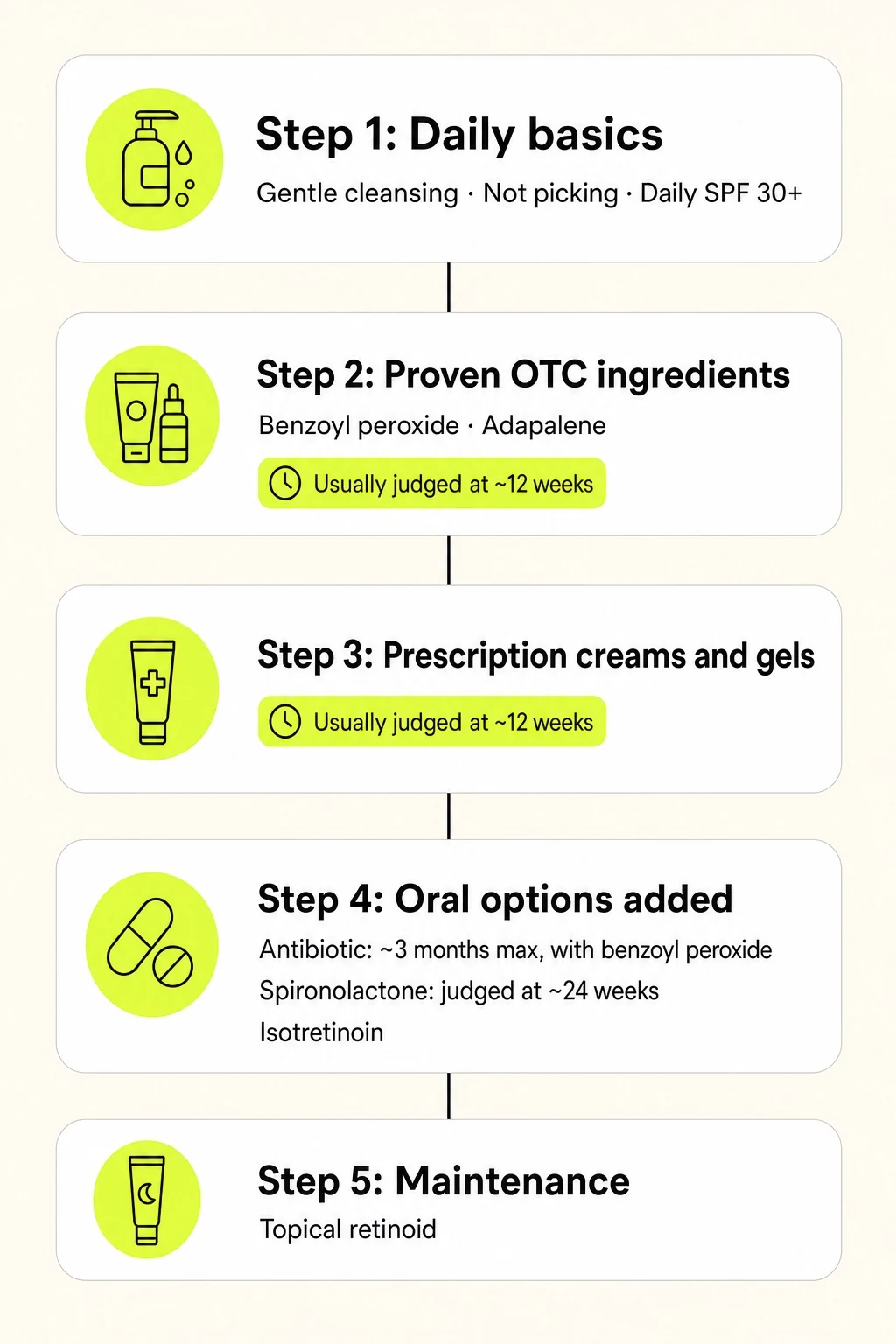
Early on, things can look worse. The same adapalene label warns that acne may appear to worsen before it improves, and that irritation usually eases with continued use. Swapping products every couple of weeks doesn't fix that. The AAD notes that trying new treatments too often can irritate your skin and cause breakouts.
What to expect: Some dryness, redness, or stinging at first, which usually eases as your skin adjusts. Fewer new breakouts tend to show up after 6 to 8 weeks, with the fuller result closer to 3 months.
Red flag: Stop the product and talk to a provider if irritation becomes severe, such as burning or swelling that keeps getting worse. Deep, painful bumps or acne that's starting to scar shouldn't wait out the full 12 weeks; those generally call for prescription care sooner.
If 12 honest weeks pass and your skin hasn't clearly improved, it's time to look past the drugstore.
When is it time for prescription treatment?
It's generally time for prescription care when acne hasn't clearly improved after about 12 weeks of consistent use. It's time sooner if your acne is painful, scarring, leaving dark marks, or wearing on your mood. The AAD advises getting a dermatologist's help if you keep seeing breakouts after following the basics.
Prescription topicals include retinoids like tretinoin and gels that combine two or three ingredients. In the same 12-week trials from the top of this article, breakout counts fell about 73% to 80% on the three-ingredient gel, compared with about 48% to 60% on the plain gel.
For breakouts driven by hormones, there's also clascoterone, a prescription cream that blocks androgen (hormone) receptors. It's approved for ages 12 and up, and the AAD calls it the first FDA-approved medication that can treat the hormonal causes of acne in both males and females.
Cost is a fair worry at this step. Prescriptions can go through your insurance, and our care team helps with the insurance paperwork, including prior authorizations. When creams and gels aren't enough on their own, oral treatment is the next layer.
What if creams and gels aren't enough?
Oral antibiotics and spironolactone are generally added on top of topicals, not swapped in for them, and each one runs on its own clock. Doxycycline and similar antibiotics have guideline support, strongest for doxycycline, but they're meant to be short-term. A 2026 clinical review says courses should generally last no more than 3 months, and the guideline calls for pairing them with benzoyl peroxide and other topicals.
Spironolactone, an oral medication for hormonal acne, is a common option when breakouts cluster along the jawline, chin, and lower face. It takes patience. In a large UK trial of adult women, 82% on spironolactone reported improvement at 24 weeks, compared with 63% on placebo, and the gap was bigger at 24 weeks than at 12. In other words, a fair verdict on spironolactone takes closer to six months than three. Our overview of oral spironolactone covers who it suits.
Accutane (isotretinoin) is generally considered the most effective option for scarring or treatment-resistant acne. The 2024 guidelines strongly recommend it for acne that's severe, scarring, causing real distress, or not responding to standard treatment, so it fits persistent acne of any severity, not just the worst cases. Whether it can clear acne for good is its own question, covered in our guide to whether acne has a permanent cure. Getting acne down is half the job; keeping it down is the other.
How do you keep acne down once it clears?
The usual answer is to keep a topical retinoid going, with or without benzoyl peroxide, after breakouts clear. The same 2026 review names that as the standard maintenance approach, and the AAD notes that this kind of treatment can keep skin clear once acne is under control. Antibiotics, by contrast, are time-limited and meant to stop.
Consistency is what makes it stick. As one Honeydew patient put it in a review: “My skin completely cleared up and the level of new breakouts has been zero to none.” They added that “…sticking with Spironolactone has been amazing.” Here's how our providers put all of this together.
Honeydew Recommends
The first step is to stop treating acne like a product hunt and start treating it like a treatment regimen with checkpoints, meaning a regimen that you see through until the end.
Whether you are starting with over-the-counter basics or prescription care, consistency beats constant experimentation every time. As Honeydew provider Jessica Cheng puts it: "I recommend following a simple, consistent routine for 8–12 weeks before evaluating its effectiveness. If acne continues despite consistent use, it is time to consider prescription treatments rather than experimenting with drugstore products."
When you are ready for that prescription step, our providers most often recommend starting with a prescription retinoid plus benzoyl peroxide and committing to a full 12-week evaluation window. Both ingredients hold the strongest dermatology guideline backing for a reason: instead of poking at one trigger while ignoring the rest, they work together to prevent clogged pores, calm inflammation, and reduce bacteria without the cumulative irritation of layering random drugstore swaps.
And give that combination time to reset your skin cycle, and use week 12 as your decision point: if breakouts haven't meaningfully dropped, your provider adjusts the dose or shifts to a deeper prescription strategy rather than leaving you to start over from scratch.
At Honeydew your first consultation with an online board-certified dermatologist is free. Membership for acne care other than Accutane starts at $25/month with an annual plan, and Accutane care starts at $50/month with an annual plan. Medications aren't included in the membership. They're prescribed to outside pharmacies and may be covered by insurance, and for some generics the cash price is lower than a copay. The membership is HSA/FSA eligible. Start your free online consultation to get a plan built around your skin.
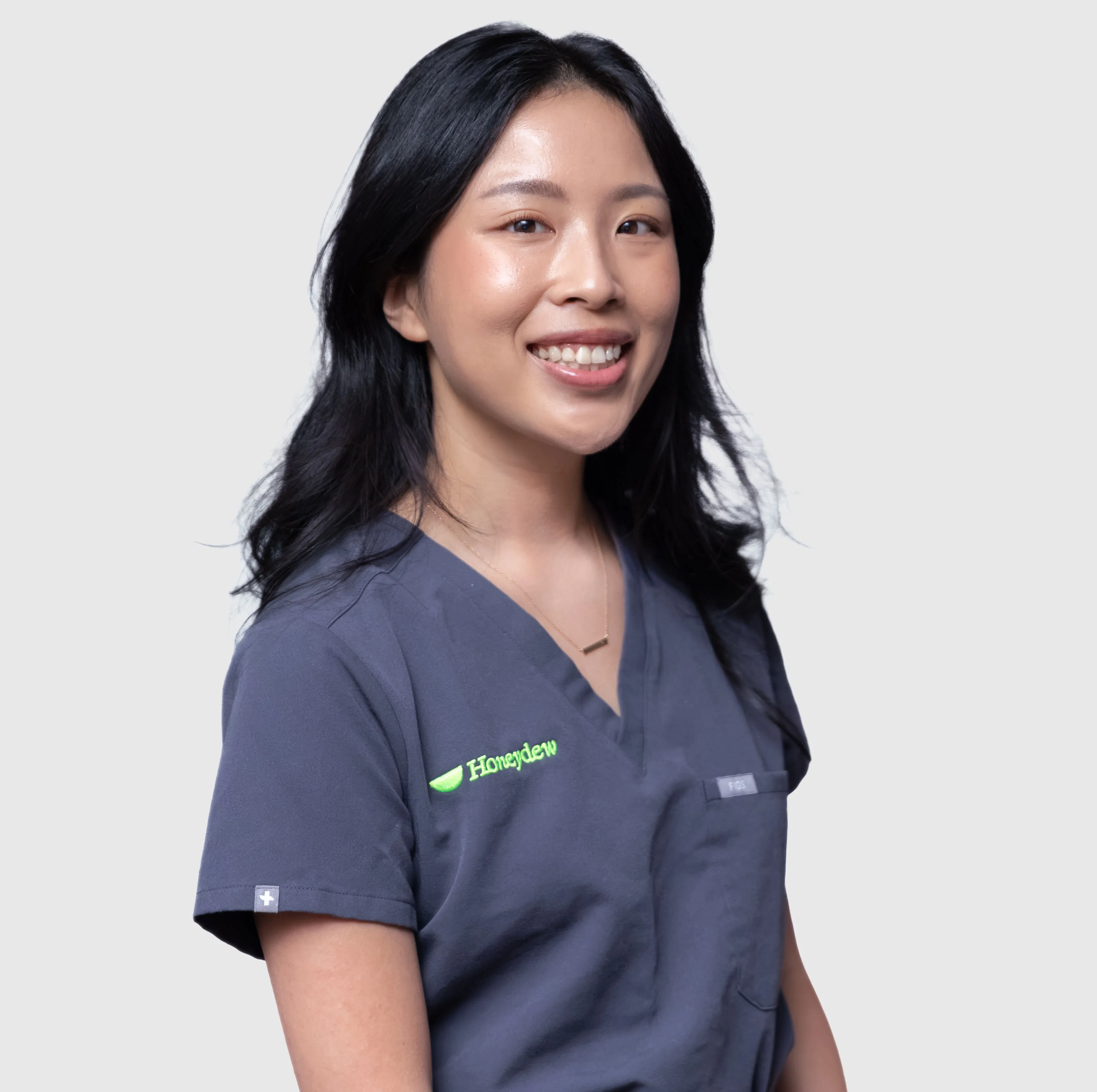

Medically Reviewed by
Jessica Cheng, FNP-BC
Nurse Practitioner